

Pool and Spa Inspection in Santa Rosa Beach: What Buyers Should Know
What if clear water and a tidy deck don’t tell the whole story about a pool? For buyers considering a home near the coast, a pool and spa inspection Santa Rosa Beach can help clarify the property’s visible condition and the operation of accessible equipment before closing. It won’t guarantee future performance or uncover every hidden defect, but it can turn observations into practical questions and next steps.
It’s reasonable to wonder whether a pump, filter, or surface issue could complicate a purchase, and what an inspection can actually establish. Local conditions matter, too: heat and humidity can encourage algae growth, strong sun can affect pool surfaces, and shifting sandy soil may contribute to cracking or leaks. These factors provide context for an assessment, but they aren’t a reason to assume a specific problem exists.
In this guide, you’ll learn what a pool inspection can reveal, which visible conditions deserve attention, and where its limits lie. You’ll also find ways to prepare for the inspection and use its findings to plan follow-up, maintenance, or a more informed purchase decision.
Table of Contents
Why arrange a pool and spa inspection in Santa Rosa Beach?
A pool can look inviting while leaving important questions unanswered. Is the surface showing visible deterioration? Does accessible equipment appear to operate during the inspection? Are there apparent safety concerns around the pool area that deserve attention? A focused assessment helps buyers understand what can be observed before purchasing and identify issues that may warrant follow-up.
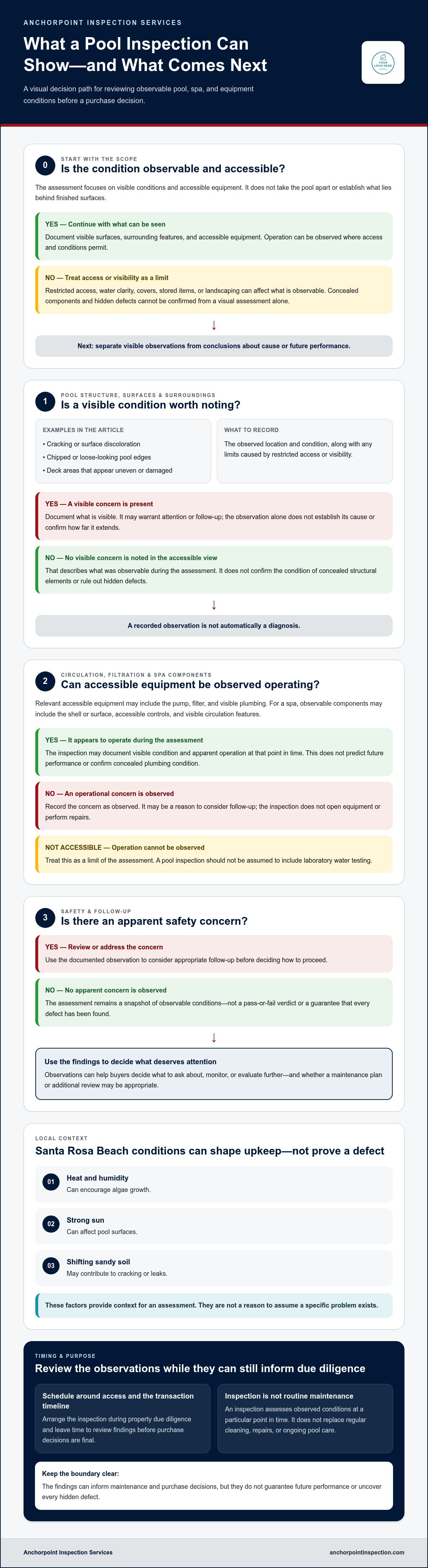
A pool and spa inspection is a focused assessment of observable conditions, including visible surfaces and accessible equipment operation. It helps buyers understand what was seen and plan informed follow-up. It isn’t a guarantee that every defect will be found or that the pool will perform a certain way in the future. The findings provide a practical snapshot to consider alongside the rest of the property information.
An inspection also serves a different purpose from routine cleaning, repairs, or ongoing maintenance. A maintenance professional typically keeps a pool clean and manages its regular operation; the Wikipedia overview of a swimming pool service technician describes that ongoing work. An inspection focuses on observed conditions at a particular point in time. It doesn’t replace regular care or diagnose every hidden issue, but it can help a buyer decide whether further evaluation or attention may be appropriate.
When should a buyer schedule a pool inspection?
Buyers may arrange a pool and spa inspection Santa Rosa Beach during property due diligence, while there’s still time to review the observations before purchase decisions are final. That timing gives you room to consider whether a visible concern calls for follow-up, a maintenance plan, or further discussion as part of the transaction.
There isn’t one schedule that fits every purchase. The inspection date depends on access to the pool and equipment, as well as the transaction timeline. Plan enough time to review the findings before a decision deadline, rather than leaving the report until the last moment.
What questions can the inspection help answer?
Think of the assessment as a way to clarify practical questions, not as a pass-or-fail verdict. Depending on what’s accessible and observable, findings may help you understand:
What visible conditions are present on the pool or spa surfaces and surrounding areas?
Does accessible circulation or filtration equipment appear to operate during the inspection?
Are there apparent safety concerns that should be reviewed or addressed?
Which observations may warrant follow-up before you decide how to proceed?
Documented observations give buyers a clearer basis for deciding what to ask about, monitor, or evaluate further. For another perspective on the value of a focused assessment, Anchorpoint’s Lynn Haven pool inspection guide discusses how inspection findings can inform property decisions. The same practical approach applies in Santa Rosa Beach: focus on what was observed and which next steps make sense for that property.
What does a pool and spa inspection examine?
A useful inspection follows what can be seen and accessed, moving from the pool’s surfaces and surroundings to its equipment and, where possible, the spa’s visible components. The aim is to document conditions that may matter to a buyer, not to take the pool apart or infer what lies behind finished surfaces.
An inspection describes visible conditions and observable operation. Concealed components and hidden defects can’t be confirmed from a visual assessment alone. That distinction helps set realistic expectations. A noted crack, stain, or equipment concern is a documented observation, not necessarily a diagnosis of its cause or a prediction of how the system will perform later.
Pool structure, surfaces, and surrounding area
The inspector can look over accessible pool surfaces, coping at the edge, and nearby decking for visible wear or deterioration. Examples worth recording include cracking, chipped or loose-looking edges, surface discoloration, and areas where the deck appears uneven or damaged. These observations help buyers identify conditions that may merit attention without assuming what caused them.
Visibility matters. Water clarity, stored items, covers, landscaping, and restricted access can affect what’s observable on the day. Surface appearance alone can’t establish the condition of concealed structural elements or confirm whether a crack extends beyond what can be seen. Findings should describe the observed location and condition, along with any limits caused by restricted access or visibility.
Pumps, filters, and spa components
Circulation depends on components such as the pump, filter, and accessible plumbing working together to move and clean water. Where equipment is accessible, an inspection may document its visible condition and whether it appears to operate during the assessment. For example, the report might note visible deterioration or an operational concern without opening equipment or performing repairs.
For a spa, observable components may include the shell or surface, accessible controls, and visible circulation features. Operation can be observed where access and conditions permit. That doesn’t establish the condition of concealed plumbing or confirm how the spa will perform over time. A pool inspection also shouldn’t be assumed to include laboratory water testing. Its focus is observable property conditions.
For more useful observations, make sure the pool area and equipment are accessible, and share information about any areas that can’t be reached. These details help clarify what could be viewed and operated on the inspection date. A pool inspection from Anchorpoint can help buyers understand documented conditions and consider appropriate next steps.
How can Santa Rosa Beach conditions affect pool inspection findings?
In Santa Rosa Beach, Gulf Coast exposure is useful context for interpreting what an inspector observes, but it doesn’t prove that a particular component is damaged. Salt air, humidity, intense sun, and periods of severe weather can affect outdoor materials and equipment over time. A pool and spa inspection Santa Rosa Beach documents visible conditions on the inspection date, helping buyers distinguish observations that deserve attention from conclusions that would require further evaluation.
Salt air, humidity, and outdoor exposure
Outdoor metal fittings, equipment enclosures, and other exposed components may show corrosion or weathering. Those signs are worth documenting, especially if they appear alongside visible deterioration, but appearance alone doesn’t establish the cause or extent. Humid conditions can also leave surfaces damp, so moisture observed during an inspection should be considered in context. It isn’t, by itself, proof of a leak, hidden damage, or a persistent moisture problem.
Sun exposure and routine use can also contribute to fading, worn finishes, or surface changes. Consider what is visible, where it appears, and whether it seems isolated or widespread. An inspection doesn’t establish an equipment’s expected lifespan or predict when a component may fail.
Storm history and visible changes
After strong weather, an inspector may observe debris, displaced items, or visible damage around the pool area. Such conditions can be recorded, but an inspection generally can’t determine from appearance alone when they occurred or whether a particular storm caused them. If the owner has maintenance records or earlier photos, those may help a buyer compare the current appearance with past conditions.
A single inspection is a snapshot, not a continuous record. The pool’s condition, water level, equipment access, and weather at the time can all shape what is observable. If an observation raises questions about a concealed issue, further evaluation may help clarify the condition.
The comparison below can help turn observations into measured follow-up rather than assumptions:
Read findings as evidence of what was visible that day. This keeps coastal exposure in perspective and helps buyers decide which observations may reflect routine wear, which merit monitoring, and which call for a closer look.
How should you prepare for and use a pool inspection?
A little preparation can make a pool inspection more useful. The goal isn’t to stage the property or hide normal wear. It’s to make relevant areas accessible, share context that may help explain what’s observed, and leave enough time to review the findings before making decisions. Treat the process as three practical steps: arrange access, provide available history, then read the report and decide what deserves attention.
Before the inspection appointment
Ask the property representative to arrange safe, clear access to the pool, spa, and accessible equipment. A clear path helps the inspector observe conditions without obstacles. Don’t move heavy items or attempt to operate equipment yourself if doing so could be unsafe. Gather any available maintenance or repair records, and note specific concerns you’d like considered.
Records can provide helpful context, but they aren’t proof that a component is currently functioning or that an earlier issue is resolved. A dated service note, for example, may explain why a repair was made, while the inspection documents what can be observed now. Share the paperwork and any relevant details about recurring concerns, such as a problem the seller has mentioned or an area that has needed attention.
After receiving the findings
Read each observation alongside its location and description. Separate questions that may need timely attention, especially apparent safety concerns or significant visible conditions, from routine maintenance notes that can inform future care. If a finding raises questions beyond a visual inspection, further evaluation may clarify the issue.
Use this sequence to turn the report into a manageable plan:
Arrange access. Confirm the pool area and accessible equipment can be reached safely on the inspection date. If something is blocked or unavailable, keep that limitation in mind when reviewing the report.
Share context. Provide available service records and a short list of concerns. Past records add history, while inspection findings describe observed conditions at the time of the assessment.
Review and sort. Note which findings raise questions about safety or a significant visible condition, and which are maintenance observations to keep in mind. Identify any item that needs clarification or further evaluation.
As you review, ask: What was observed? Where was it found? Does the report describe a limitation? What next step, if any, would help answer the remaining question? This keeps the focus on evidence instead of treating every note as an urgent defect. The home inspection report guide offers additional context for interpreting observations and using them to plan follow-up.
For a pool and spa inspection Santa Rosa Beach, clear access and relevant history help make the findings easier to understand and act on. Anchorpoint’s pool inspection service documents observable conditions to help buyers consider practical next steps.
Book a Santa Rosa Beach pool and spa inspection with Anchorpoint
Buying a property with a pool or spa adds another set of conditions to understand before making a decision. Anchorpoint Inspection Services provides pool inspections for buyers who want clear information about what can be observed at the property. The purpose is practical: document accessible conditions, explain what those observations may mean, and help you decide whether follow-up is appropriate.
A pool inspection isn’t a guarantee that every concealed issue will be identified or that equipment will keep operating in the future. It reflects conditions visible and accessible on the inspection date. Keeping that boundary in mind helps you use the findings as a decision-making tool, rather than treating them as a promise or an alarm.
What to expect from a professional inspection
A professional assessment takes a methodical look at accessible pool and spa areas and observes equipment operation where conditions permit. Findings should describe what was seen rather than leap from a visible sign to an unsupported conclusion about its cause. If an observation raises a question beyond the inspection’s scope, the report can help identify what may need additional evaluation.
That clarity matters. A documented observation can help you distinguish a condition to monitor from one that deserves timely attention or further review. Anchorpoint is owned and operated by Florida-licensed home inspector John R. Gramlick III, with a focus on providing buyers useful information about a property’s observed condition.
Plan your next step in Santa Rosa Beach
Arrange the inspection with the property’s access and transaction deadlines in mind. Clear access to the pool and equipment supports a more useful assessment. Once you receive the findings, keep the report available when considering a particular concern. The observations can help focus follow-up, though diagnosis or repair may require expertise beyond an inspection.
If you’re weighing what a finding means, start with its description and location, then consider whether it affects a decision you need to make before closing. Some observations may inform routine maintenance planning; others may prompt a closer look. Either way, a clear record helps you move forward with more context and less guesswork.
For a pool and spa inspection Santa Rosa Beach buyers can use to understand observed conditions and plan sensible follow-up, schedule a pool inspection with Anchorpoint.
Move forward with a clearer plan for your property
A pool can be an enjoyable part of a Santa Rosa Beach home, and understanding its condition can help you make a more confident decision about what comes next. Treat the inspection report as a practical reference: use it to organize questions, weigh follow-up needs, and plan care that fits the property rather than reacting to uncertainty.
If you’re still within your purchase timeline, consider arranging a pool and spa inspection Santa Rosa Beach while there’s time to review the findings and decide on next steps. Anchorpoint Inspection Services offers pool inspections to help buyers understand observed conditions without turning individual observations into promises about future performance.
Take the next step at a pace that works for your transaction. Arrange your pool inspection with Anchorpoint and move ahead with a clearer basis for your decision.
Frequently Asked Questions
Is a pool inspection necessary when buying a home in Santa Rosa Beach?
A pool inspection can be a useful part of a buyer’s due diligence, though whether it’s necessary depends on your concerns and purchase plans. It helps you evaluate the pool as a property feature rather than relying only on its appearance during a showing. Buyers in Santa Rosa Beach and nearby communities, including Lynn Haven, Panama City, Panama City Beach, Callaway, Southport, Mexico Beach, Port St. Joe, Fort Walton, Niceville, Destin, Pensacola, Gulf Shores, and San Destin, can use the same approach.
Can a pool inspection identify every problem with the equipment?
No. An inspection can document accessible, observable equipment conditions, but it can’t establish that every internal or concealed component is free of problems. For instance, an exterior view of a pump doesn’t reveal the condition of every internal part. If a report notes unusual noise, visible wear, or another concern, treat that observation as a starting point for deciding whether further evaluation would help.
How much does a pool and spa inspection cost in Santa Rosa Beach?
The cost depends on the property and the scope of the inspection, so a general online average may not reflect the service needed for your purchase. Base your budget on the fee for the specific inspection rather than assuming optional diagnostic work or repairs are included. Keep the inspection fee separate from any costs that may arise if you later choose to investigate or address a reported concern.
What happens if the inspection finds a pool safety concern?
A safety-related observation gives you a reason to pause and understand what was seen, where it was located, and whether further evaluation is appropriate. Review the report and consider any purchase implications. If the concern involves a feature that needs technical assessment or correction, further evaluation can help clarify next steps. An inspection documents observations; it doesn’t itself make repairs or determine every applicable safety requirement.
Does a pool inspection include water testing?
Don’t assume that a pool inspection includes laboratory water testing or a full chemical analysis. A visual property assessment and water-quality testing answer different questions: one records observable conditions, while testing measures water characteristics. If water chemistry is important to your plans, treat it as a separate item to address. For example, a clear-looking pool doesn’t by itself tell you whether its chemical balance is suitable for use.
Should the pool equipment be running during an inspection?
Equipment operation can provide useful information when it’s accessible and operating safely, but buyers shouldn’t switch on unfamiliar equipment themselves. Arrange access through the property representative and share any known operating instructions or limitations. If equipment is off, inaccessible, or appears unsafe to operate, that may limit what can be observed. Read the resulting report in light of those conditions rather than treating it as confirmation of normal operation.
Can a pool inspection assess both a swimming pool and a spa?
Yes, an inspection can consider a pool and a spa at the same property, with observations shaped by access and what can be seen or operated safely. A spa may have separate controls and circulation components, so note any specific questions about it before the appointment. The assessment remains a snapshot of observable conditions, not a guarantee about concealed components or performance after the inspection date.
Comments