

Moisture Problem Home Inspection in Florida: Identification and Detection Guide
A dry-looking wall can quietly conceal trapped water without showing a single visible stain. If you feel uneasy trying to tell the difference between normal coastal humidity and an active leak behind the baseboards, you aren't alone. Sustained ambient humidity often masks serious building envelope failures, leaving buyers and homeowners worried about structural decay and strict insurer requirements. That is why investing in a detailed moisture problem home inspection Florida buyers rely on is essential for safeguarding your purchase.
Understanding how inspectors trace moisture helps you protect your investment and approach any transaction with confidence. This guide walks you through the exact diagnostic tools qualified inspectors use to identify hidden water, highlights the most vulnerable moisture zones across slab and crawlspace homes, and explains how to interpret moisture problem findings on a comprehensive report.
Table of Contents
Why Florida Properties Are Uniquely Prone to Moisture Problems
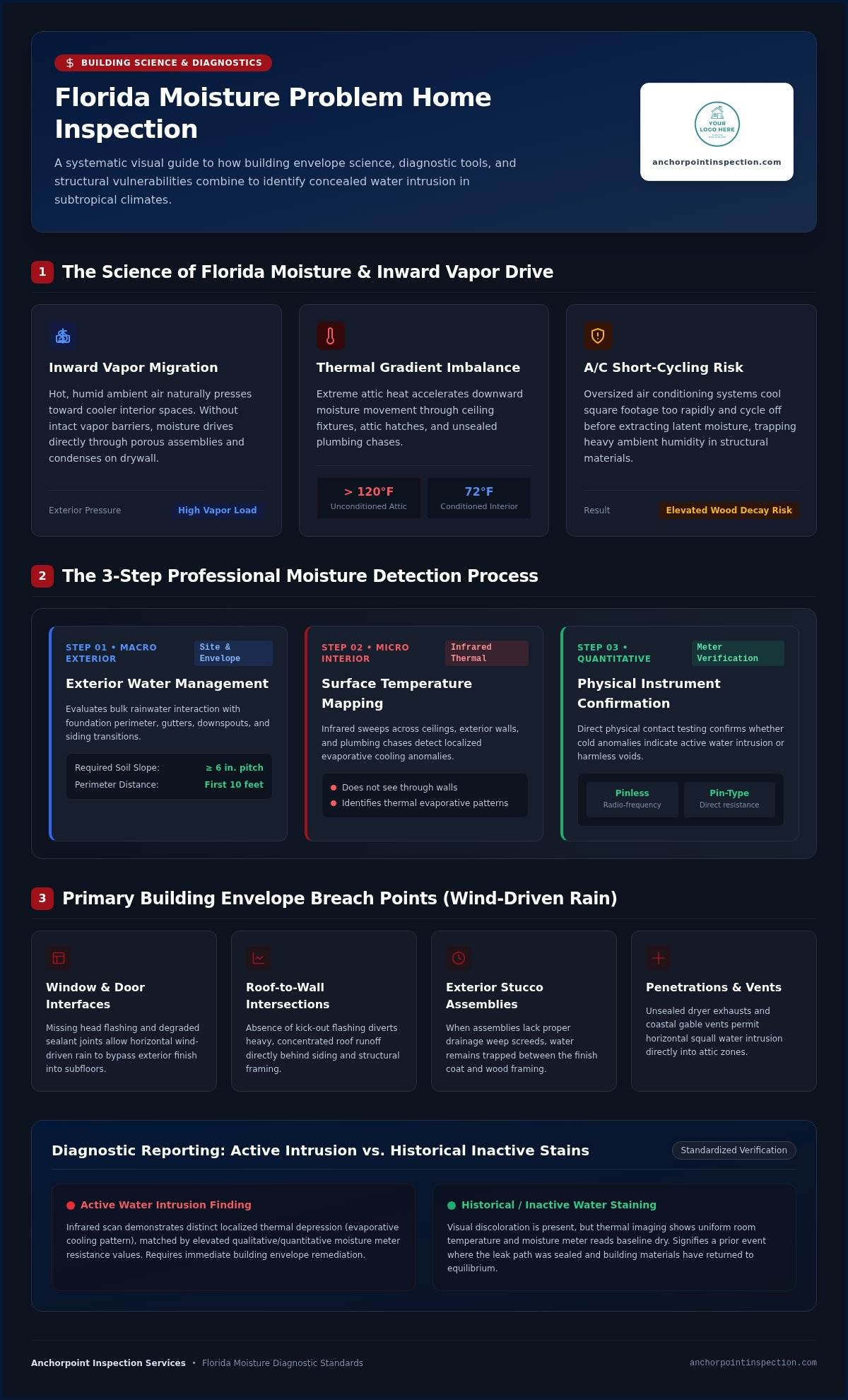
Florida homes face extreme building science challenges unlike properties in most other regions. Between high water tables, relentless coastal humidity, and sudden tropical weather, structures are surrounded by moisture from every angle. When performing a moisture problem home inspection Florida inspectors focus on how moisture penetrates and migrates through building assemblies. In our warm coastal climate, outdoor moisture moves toward cooler, conditioned indoor spaces. When hot, humid air presses against exterior walls and meets an interior cooled to 72 degrees, water vapor naturally forces its way inside.
Mechanical systems can inadvertently worsen these environmental loads. When an air conditioning system is oversized for the square footage it serves, it cools the home too quickly and shuts off before pulling latent moisture from the air. This short-cycling leaves interior air humid and heavy. Over time, that ambient indoor dampness settles into organic materials, elevating the risk of structural decay.
The Role of Subtropical Humidity and Vapor Drive
Northwest Florida's sustained Gulf humidity creates continuous vapor pressure against residential walls and rooflines. If exterior vapor barriers are compromised or missing, ambient water vapor pushes directly through porous building materials and condenses against drywall. In unconditioned attics, summertime temperatures routinely exceed 120 degrees, which accelerates vapor migration down through ceiling fixtures, plumbing penetrations, and attic hatches. To verify whether vapor drive is wetting building materials, inspectors test framing and drywall using calibrated pin and pinless moisture meters, distinguishing normal seasonal humidity from trapped condensation.
Severe Weather and Wind-Driven Rain in Coastal Florida
Along the coast, tropical squalls and storms push rainwater horizontally against exterior cladding at high speeds. This wind-driven rain exploits micro-cracks in exterior stucco, unsealed window sills, and exposed soffit joints. When stucco assemblies lack proper drainage weep screeds, water remains trapped between the finish coat and structural wall framing, leading to hidden deterioration.
Window and door interfaces: Missing head flashing or degraded caulking allows water to enter subfloor assemblies.
Roof-to-wall intersections: Missing kick-out flashing diverts heavy roof runoff behind exterior siding.
Penetrations and vents: Gable vents and unsealed dryer vents invite horizontal rain intrusion.
Identifying these exterior weak spots alongside a detailed roof certification inspection Florida buyers prioritize ensures exterior breaches are flagged before moisture reaches structural framing.
How Home Inspectors Detect Hidden Moisture: A Step-by-Step Guide
Locating trapped water requires a systematic approach rather than guesswork. Professional inspectors follow an orderly workflow that moves from the macro-environment outside down to micro-details inside. Rather than relying on eyesight alone, a skilled inspector correlates physical building paths with calibrated diagnostic instrumentation. During an objective moisture problem home inspection Florida buyers rely on, this tiered process helps differentiate between superficial cosmetic blemishes and active water penetration.
Step 1: Visual Assessment of Exterior Drainage and Envelopes
The evaluation begins outside by tracing how bulk rainwater interacts with the structure. Inspectors check site grading to confirm soil slopes away from the foundation at a minimum pitch of six inches over the first ten feet. Gutter discharge points, downspout extensions, and roof valleys are evaluated to see if they concentrate runoff against exterior walls. The inspector also checks sealant joints around window casings, door thresholds, and siding transitions for breach points.
Step 2: Infrared Thermal Imaging for Temperature Anomalies
Once inside, the inspector conducts an infrared sweep across ceilings, exterior walls, and plumbing chases. Contrary to popular misconception, thermal cameras do not see through walls or detect moisture directly. Instead, they read tiny surface temperature differentials. Evaporating water creates a localized cooling effect that shows up as an irregular dark pattern on the screen. These thermal signatures serve as an investigative map, flagging specific spots that demand physical testing.
Step 3: Moisture Meter Verification and Psychrometric Readings
Every thermal anomaly must be confirmed using contact tools. First, a pinless radio-frequency meter scans drywall or flooring without puncturing the finish, checking for elevated subsurface density. If readings suggest wet conditions, an inspector uses a calibrated pin meter to measure actual electrical resistance within the material.
Wood framing and subfloors: Normal readings sit below 15% to 17% Wood Moisture Equivalent (WME). Readings reaching 20% WME or higher indicate conditions supporting active rot and decay.
Drywall: Pin meter readings over 17 WME represent elevated dampness, while numbers exceeding 20 WME point to active liquid intrusion.
Finally, digital thermo-hygrometers measure ambient indoor temperature, dew point, and relative humidity. In accordance with Florida Department of Health indoor moisture guidelines, indoor relative humidity should remain strictly below 60% (ideally between 30% and 50%) to prevent microbial germination. If you are preparing to purchase a home or want clarity on an existing property, scheduling a comprehensive home inspection provides the unbiased diagnostic clarity you need to move forward safely.
Critical Moisture Inspection Zones in Florida Homes
Regional building styles dictate exactly where water accumulates. Unlike northern properties built over full basements, Florida architecture relies almost entirely on monolithic slab-on-grade foundations or raised pier-and-beam crawlspaces. When conducting a moisture problem home inspection Florida inspectors focus on specific micro-zones where structural design, heavy mechanical cooling, and ground dampness converge.
Attics and Unconditioned Roof Cavities
Unconditioned roof spaces become extreme heat traps during long summers. When chilled air moves through supply ducts, uninsulated metal plenums or damaged flex ducts drop below the dew point immediately. The resulting duct sweat drips steadily onto ceiling drywall and surrounding insulation. In addition, wind-driven rain can penetrate roof penetrations, valleys, and vent boots, allowing water to track along rafters far away from the exterior puncture point before dripping.
Crawlspaces Versus Slab-on-Grade Foundations
Both primary foundation styles present distinct moisture transmission risks across coastal Florida:
Raised crawlspaces: High water tables allow ground dampness to evaporate continuously into floor joists. Without a continuous, well-sealed vapor retarder laid over the exposed earth, subfloor framing absorbs this moisture and softens over time.
Slab-on-grade construction: Poured concrete remains porous. If the polyethylene vapor barrier beneath the slab was punctured during construction or has degraded, hydrostatic pressure forces soil moisture upward. This capillary action loosens flooring adhesives, warps engineered planks, and causes ceramic tile to buckle.
Evaluating these foundation details alongside an insurance inspection Florida home buyers schedule helps uncover potential structural and insurability concerns before closing.
Plumbing Enclosures and Mechanical Closets
Mechanical closets housing the indoor air handler represent one of the highest risk areas in the home. Warm, humid air combined with cool evaporator coils causes primary drain lines to clog with algae quickly. When the secondary drain pan or float switch fails, overflow water spills into interior wall cavities and subflooring.
Behind the scenes, slow plumbing failures around recessed shower valves, supply lines, and toilet seals can leak for months without puddling on bathroom floors. A qualified inspector systematically tests these wet areas, evaluating water heater pans and appliance supply lines to verify everything remains properly sealed and dry.
How to Read and Interpret Moisture Findings on Your Inspection Report
Opening an inspection report filled with technical terminology can feel overwhelming. A thorough moisture problem home inspection Florida buyers complete should bring clarity, not alarm. The goal is to provide empirical data so you can distinguish between minor routine upkeep, historic building scars, and active structural defects. To get familiar with the general layout of our documentation, you can explore our guide on having your home inspection report explained.
Active Leaks Versus Historical Dry Stains
Water stains tell a story, but they don't automatically mean there is a current crisis. When an inspector spots a watermark on drywall or subflooring, contact testing determines whether the area is wet. If the meter registers base levels (below 15% WME on wood or 17 on drywall), the stain represents a historical event where the root issue was likely addressed. In contrast, elevated readings indicate active, ongoing moisture intrusion that requires tracing the water source immediately.
Understanding Report Severity Classifications
A clear report organizes moisture findings into distinct priority categories to guide your next decisions:
Routine Maintenance Items: Minor conditions such as dried exterior caulking around window trim, downspout extensions discharging too close to grade, or minor bathroom grout gaps.
Significant Defects: Active plumbing supply leaks, decayed subflooring, framing damage, or saturated insulation.
Safety Hazards: Water dripping onto breaker panels, saturated drywall near live branch circuits, or electrical conduits exposed to standing water.
Next Steps: Professional Evaluation and Unbiased Assessment
Florida law enforces strict conflict of interest rules under Chapter 468. Companies that perform property assessments cannot also perform remediation work on that same property within a twelve-month window. Because an independent inspection firm does not sell remediation or contracting services, your report remains entirely unbiased and objective.
When an active defect is identified, the report directs you toward the appropriate licensed tradesperson (such as a certified roofing contractor, master plumber, or structural engineer) for further scope and estimates. Having documented, neutral data gives you clear leverage during real estate negotiations to request repairs or financial credits. To secure an objective evaluation for your property, book a comprehensive home inspection with our experienced team today.
Actionable Maintenance Strategies to Prevent Florida Moisture Damage
Preventing water damage in a coastal environment requires simple, consistent habits rather than expensive structural overhauls. Florida's high heat and sudden squalls will quickly test any weak seal or sluggish drain line. Staying ahead of these environmental pressures keeps small maintenance tasks from turning into major structural repairs. A professional moisture problem home inspection Florida homeowners book provides a clear diagnostic baseline, but everyday stewardship ensures your building envelope remains resilient long after the inspection is complete.
Managing Interior Relative Humidity and HVAC Performance
Controlling indoor humidity is your first line of defense against microbial growth and hidden condensation. Keep indoor relative humidity balanced between 40% and 55% across all seasons. In warm weather, never turn your cooling system completely off while away on vacation; leave thermostats set no higher than 78 degrees to ensure the unit runs periodically to dehumidify the air. On the first of every month, pour a cup of regular white vinegar down the primary condensate drain line access port. This simple step breaks down algae slime before it causes the line to back up and overflow into your home.
Exterior Water Management and Building Envelope Care
Managing water outside keeps liquid loads from saturating foundations and walls. Simple perimeter adjustments make a substantial difference:
Extend downspouts: Ensure gutter downspouts discharge runoff at least five feet away from foundation walls to prevent soil saturation near footings.
Maintain vegetation clearances: Prune trees and shrubs so branches remain at least twelve inches away from exterior siding and roof edges, promoting sunlight and cross-ventilation.
Inspect exterior sealants: Examine caulking around window frames, entry door headers, and exterior hose bibbs every spring, replacing dried or separated beads with polyurethane sealant.
Routine Professional Inspections and Maintenance Checks
Visual self-checks are valuable, but certain spaces remain difficult to evaluate safely without specialized training. Catching early duct sweating in a tight attic or checking subfloor framing beneath a raised cottage prevents hidden decay from spreading unseen. Whether you need a 4-point review for an insurer, an 11-month warranty survey on newer construction, or a periodic checkup, scheduling a comprehensive home inspection delivers the clear diagnostic oversight you need to preserve your property equity.
Protecting Your Florida Home with Unbiased Diagnostic Clarity
Managing moisture along the Gulf Coast comes down to understanding how ambient humidity, exterior weather, and mechanical systems interact with your structure. Tracing water paths before they cause framing rot or subfloor decay gives you complete control over your investment. By learning how non-invasive diagnostic tools confirm hidden dampness and knowing how to prioritize report findings, you can make clear, confident decisions whether buying, selling, or maintaining your property.
When you need reliable answers about a property's condition, partnering with an independent professional ensures your interests stay protected. Owned and operated by licensed Florida home inspector John R. Gramlick III, Anchorpoint Inspection Services utilizes non-invasive diagnostic tools, including infrared thermal imaging, to deliver thorough assessments across Bay County. Because we never perform repairs or remediation, your report reflects pure, unbiased facts without sales pressure. Schedule your comprehensive home inspection with Anchorpoint Inspection Services today and step forward with total peace of mind.
Frequently Asked Questions
What tools do home inspectors use to find hidden moisture in Florida homes?
Inspectors rely on a combination of high-resolution infrared thermal cameras, calibrated pin and pinless moisture meters, and digital thermo-hygrometers. During a moisture problem home inspection Florida buyers schedule in Panama City or Lynn Haven, thermal cameras identify evaporative cooling patterns across building surfaces. Inspectors then verify suspected damp areas using physical moisture meters to record exact moisture percentages without damaging drywall, flooring, or trim.
Can a standard home inspection detect water damage behind bathroom shower walls?
Yes, non-invasive diagnostic tools can detect trapped water behind shower enclosures without dismantling wall tile. While home inspectors perform visual, non-destructive evaluations under Florida licensing standards, thermal imaging cameras and pinless radio-frequency meters pick up elevated moisture levels within wall cavities. This testing reveals concealed supply line leaks, failed shower pan liners, or degraded grout seals before structural framing decay spreads into adjoining rooms.
Is high indoor humidity considered an inspection defect in Florida properties?
High indoor humidity is documented as an environmental condition that can cause functional building defects if left unaddressed. Inspectors use digital hygrometers to evaluate whether indoor relative humidity exceeds the recommended 60% threshold. Sustained elevated levels often signal short-cycling from an oversized air conditioning system, inadequate attic insulation, or duct leakage. Inspectors highlight these readings to help homeowners prevent accelerated organic growth and structural wood rot.
What is the difference between active water intrusion and an old water stain?
The primary difference lies in current moisture content. An old water stain registers baseline, dry readings when tested with a calibrated moisture meter, indicating a past leak that has since dried or been resolved. Active water intrusion registers elevated readings (exceeding 17 WME on drywall or 20% on structural framing), proving that liquid water is currently penetrating the building assembly and requires tracing the active source immediately.
Does a home inspection report include mold remediation or air quality testing?
No, standard home inspections focus on visual defects and structural moisture pathways rather than remediation or environmental lab analysis. Under Florida law, mold assessment and mold remediation require separate licensing, and firms cannot remediate properties they evaluate. Anchorpoint Inspection Services maintains an unbiased diagnostic role and does not sell mold remediation services. If an inspector identifies apparent microbial growth, they document the underlying moisture source.
How does moisture intrusion affect Florida homeowner insurance eligibility?
Active moisture intrusion or unresolved water damage stains can lead insurance carriers to deny coverage or cancel policies across coastal Florida. During four-point insurance inspections, carriers scrutinize plumbing systems and roofs for active leaks, deteriorated drain lines, or past ceiling water marks. Because many Florida policies cap water damage coverage under strict sublimits, underwriters routinely require documented proof of professional repairs before issuing coverage.
Will an inspector check inside crawlspaces for ground moisture and plumbing leaks?
Yes, readily accessible crawlspaces are physically traversed and evaluated during a comprehensive inspection. In coastal communities where older homes sit on raised foundations, inspectors enter crawlspaces to examine wooden subflooring, floor joists, and plumbing waste lines. They verify the presence of continuous ground vapor retarders, check for standing groundwater, and test structural timber for elevated moisture content caused by high water tables.


Comments