

15 Essential Questions to Ask a Home Inspector Before Hiring in 2026
In Florida's 2026 real estate market, your home inspector isn't just a technical auditor; they're your primary advocate for securing affordable homeowners insurance. Knowing the right questions to ask a home inspector before hiring can mean the difference between a smooth closing and a rejected insurance application. You're likely feeling the weight of potential hidden structural issues or the anxiety of failing a 4-Point inspection required by your carrier. It's perfectly normal to feel overwhelmed by the technical jargon surrounding wind mitigation and coastal risks.
This guide will empower you with an expert checklist to ensure your professional is qualified to protect your investment and meet the latest 2026 insurance standards. We'll walk through essential credentials, specialized Florida forms like the updated OIR-B1-1802, and the specific reporting details that insurance companies now demand. By the end, you'll have a clear framework for vetting professionals and the confidence that your inspector understands exactly how to safeguard your future home. Let's turn that uncertainty into a structured plan for your next property walkthrough.
Table of Contents
Why Interviewing Your Inspector is Non-Negotiable in the Florida Market
In Florida, a home purchase involves more than just aesthetics; it's a careful calculation of risk and resilience. The stakes are uniquely high here because a single missed detail can lead to an uninsurable property or massive repair bills after a storm. This is why the specific questions to ask a home inspector before hiring are so vital to your success. You aren't just looking for a technician to walk through the house. You need a partner who understands how hurricane-hardening and insurance eligibility impact your financial future.
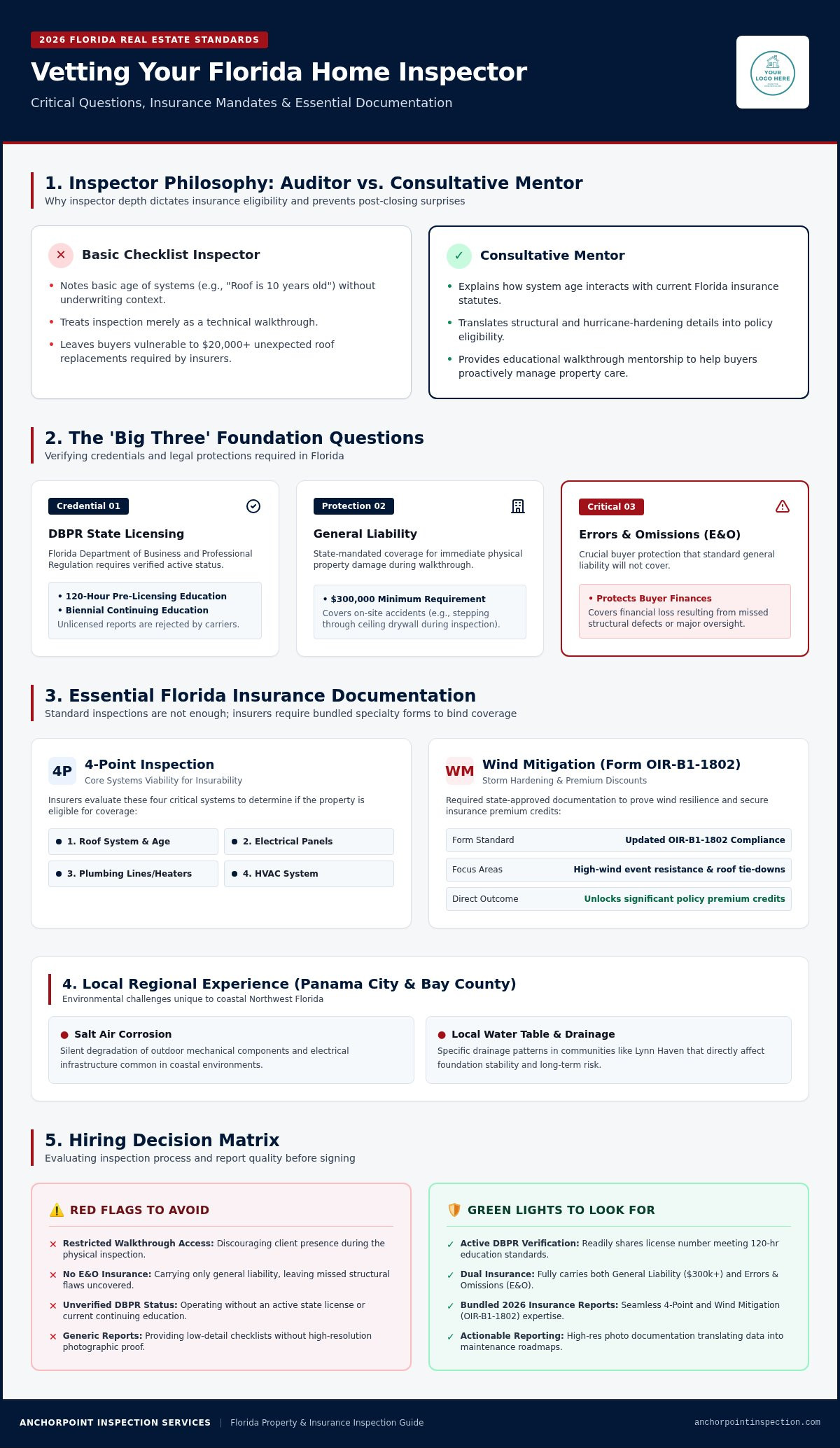
A "checklist" inspector might tell you a roof is ten years old and move on to the next room. A consultative mentor, however, will explain how that age interacts with current Florida statutes and your ability to secure a policy. This level of detail prevents the "buyer's remorse" that occurs when new owners discover their move-in ready home requires a $20,000 roof replacement just to satisfy an underwriter. By asking the right questions upfront, you move from a place of anxiety to a position of empowered decision-making.
The Link Between Inspections and Florida Insurance Premiums
In our state, a standard home inspection is often just the beginning of the process. While it provides a great overview of the home's condition, most Florida insurers require specialized documentation before they will even offer a quote. You must ask if your inspector is proficient in the nuances of 4-point and wind mitigation reports. These documents focus on the four critical systems (roof, electrical, plumbing, and HVAC) and the home's ability to withstand high-wind events. For a deeper look at these requirements, see our 2026 Guide to Florida Home Insurance Inspections.
Local Knowledge: Why Panama City Experience Matters
Panama City and the surrounding Panhandle present environmental challenges that an out-of-state or national inspector might overlook. Salt air corrosion can silently degrade mechanical components, and local drainage patterns in areas like Lynn Haven require a keen, experienced eye. When researching questions to ask a home inspector before hiring, always include a query about their specific tenure in Bay County. An inspector who has seen how local foundations react to our unique water table provides a layer of protection that raw data alone cannot offer. This local perspective transforms a simple report into a roadmap for proactive care and long-term property management.
The 'Big Three' Questions: Licensing, Insurance, and Credentials
Vetting your professional begins with three foundational pillars. While many homeowners focus on the bottom line, the most important questions to ask a home inspector before hiring center on their legal and financial standing. In 2026, Florida's regulatory environment remains strict, yet there are still gaps that an uninformed buyer might fall through. Establishing these facts early ensures you're working with a legitimate expert rather than a hobbyist.
Verifying Florida State Credentials
Every home inspector in Florida must hold an active license from the Department of Business and Professional Regulation (DBPR). You should ask for their license number and verify it immediately on the DBPR website. An "active" status is the only one that ensures the inspector has met the state's 120-hour pre-licensing education and biennial continuing education requirements. Hiring an unlicensed individual is a high-risk gamble; their reports won't be accepted by lenders or insurance carriers, which can stall your closing indefinitely. You can also reference the Consumer Financial Protection Bureau's inspection checklist to see how federal guidelines suggest vetting independent professionals during your transaction.
Liability vs. E&O Insurance: Protecting the Client
Understanding the difference between insurance types is where many buyers feel confused. Florida law requires inspectors to carry a minimum of $300,000 in general liability insurance. This covers physical damage they might cause during the walkthrough, like accidentally stepping through an attic ceiling. However, Errors and Omissions (E&O) insurance is not statutorily mandated in Florida. E&O covers your financial losses if the inspector misses a major defect, such as a failing foundation or a hidden roof leak that later costs thousands to repair.
Research suggests that only about 30% of Florida inspectors voluntarily carry E&O coverage. A true professional should carry both General Liability and E&O insurance to protect your financial interests from both physical accidents and professional oversights. If an inspector lacks E&O, you have very little recourse if a significant issue is overlooked.
Experience and Advanced Certifications
Beyond state minimums, look for credentials from reputable organizations like InterNACHI or ASHI. These certifications signal a commitment to higher standards of practice and ongoing technical training. Ask how many years they've spent in the field or in related construction trades. An inspector with a background in local building practices can often spot subtle signs of aging that a less experienced eye might miss. For those seeking a comprehensive home inspection from a veteran-owned local operation, these credentials are the starting point for a trusted partnership. This level of experience is what transforms a standard report into a valuable educational tool for your future home maintenance.
Florida-Specific Questions: Insurance Reports and Specialized Systems
Moving beyond basic credentials, your search for questions to ask a home inspector before hiring must address the specific technical reports required by Florida carriers. In our unique market, a general overview of the property's condition is only half the battle. You also need an inspector who can provide the precise documentation underwriters demand to verify a home's resilience and system age. Without these specialized forms, you may find it impossible to secure a policy or qualify for essential premium discounts.
The Insurance 'Bundle': 4-Point and Wind Mitigation
Florida insurers focus heavily on the "Big Four" systems and wind resistance. You should ask if your inspector can perform a 4-Point Inspection and a Wind Mitigation Report during the same visit as your comprehensive walkthrough. This bundling is standard practice and ensures all data is collected simultaneously. Crucially, ask if they utilize the updated Uniform Mitigation Verification Inspection Form OIR-B1-1802 (Rev. 04/26). Using an outdated form version can lead to immediate underwriting rejections and lost credits. You might also ask: "Will your report help me qualify for windstorm mitigation credits?" These credits can significantly lower your annual premiums by documenting features like hurricane straps or impact-resistant glass. If the home is older, a Roof Certification Inspection Florida is often necessary to prove the roof has at least five years of remaining life. For more on the logistics of these appointments, consult the CFPB guide to scheduling a home inspection.
Specialized Features: Pools and New Construction
If you're looking at properties in Lynn Haven or Panama City Beach, you'll likely encounter specialized systems that require extra attention. For homes with water features, ask: "Are you trained in Expert Pool Inspection safety standards?" Standard licenses don't always cover the technical complexities of pool pumps, heaters, and safety barriers. For buyers of new builds, the process is different. You should inquire about New Construction Phase Inspections to catch structural or mechanical issues before the drywall goes up. Additionally, ask if they provide an 11-month warranty inspection. This allows you to identify defects while the builder is still contractually obligated to fix them. Finally, ask how they evaluate mechanical systems in high-humidity environments. Our coastal air accelerates corrosion, and an inspector must know how to spot early signs of failure in HVAC coils and electrical components.
Evaluating the Inspection Process and Report Quality
A home inspection is a collaborative process, not just a technical checklist. When considering questions to ask a home inspector before hiring, you should focus on how the information will be shared with you. A quality professional doesn't just hand over a PDF; they act as a mentor who helps you understand the property's health. You should always ask if you can attend the inspection and participate in a verbal walkthrough at the end. This allows you to see defects firsthand and ask for clarification on the severity of specific findings before the final report is even written.
The 'Walkthrough' Test: Mentorship vs. Data Entry
We believe that an on-site summary is essential for lowering your anxiety. If an inspector discourages your presence, it's a significant red flag. First-time buyers, in particular, benefit from seeing how systems operate and learning where shut-off valves are located. This interactive approach ensures you don't just receive raw data, but a home inspection report explained through the lens of practical homeownership. You should also ask what specialized tools they use. A diligent inspector utilizes thermal imaging cameras and moisture meters to detect hidden ceiling leaks or insulation gaps that the naked eye simply cannot see.
Reviewing a Sample Report
Before you commit, ask to see a sample report for a property similar to the one you're buying. Not all reports are created equal. You want to see high-resolution photos with clear annotations and a dedicated summary section that highlights major safety or structural concerns. Avoid reports filled with generic maintenance tips that obscure the actual condition of the home. In Florida's fast-paced market, where inspection periods are often limited to 10 or 15 days, report turnaround time is critical. Ask if you'll receive your final results within 24 hours. A delay in reporting can eat away at your time to negotiate repairs or obtain specialized contractor quotes.
If you're ready to partner with a team that prioritizes clarity and education, schedule your comprehensive home inspection today to ensure your investment is fully protected.
Making Your Decision: Red Flags and Green Lights
Choosing a professional to evaluate your future home requires synthesizing all the technical data and personal interactions you've gathered. The questions to ask a home inspector before hiring serve as a filter to separate volume-based inspectors from dedicated consultants. You aren't just looking for someone to identify defects; you're looking for a partner who will help you understand the house as a complex system. A professional who welcomes your scrutiny is likely one who takes immense pride in their accuracy and transparency.
Several indicators can help you finalize your choice. A major "green light" is an inspector who treats the process as an educational partnership. They should provide transparent answers about insurance report formats and demonstrate a deep understanding of Florida's evolving building codes. Conversely, a significant "red flag" is an inspector who discourages you from attending the walkthrough or provides vague answers about their specific experience with coastal risks. If an inspector seems rushed or dismissive during the interview, they'll likely bring that same energy to the physical inspection of your home.
The 'Price vs. Value' Debate
In the Panama City market, it's tempting to select an inspector based solely on the lowest quote. However, a "cheap" inspection often suggests a rushed job that misses critical details. We encourage you to view this service as a "resilience audit" for your future investment. A missed structural issue or an incorrectly filed insurance form can cost you thousands in denied coverage or unexpected repairs. You should also ask about their policy for follow-up questions. A diligent mentor remains available after the report is delivered to ensure you feel confident in your next steps, whether that involves negotiating repairs or planning long-term maintenance.
Why Anchorpoint Inspection Services Fits the Criteria
Anchorpoint Inspection Services, led by John R. Gramlick III, is built on a foundation of professional authority and supportive reassurance. As a veteran-owned local operation in Bay County, we understand that our role is to lower your anxiety through clarity and technical expertise. We specialize in the specific 4-point and wind mitigation inspections that Florida carriers demand, ensuring your report is an asset rather than a hurdle during the closing process. Our commitment to a mentor-style approach means we don't just provide raw data; we provide the context you need to manage your home efficiently.
If you're ready to move forward with a thorough, detail-oriented professional who views your safety as a personal accountability, we're here to help. Schedule a comprehensive home inspection for your Lynn Haven or Panama City Beach property today and gain the confidence that your investment is fully protected.
Securing Your Investment with Confidence
Navigating the Florida real estate market in 2026 requires more than just luck; it demands a structured approach to due diligence. By mastering the questions to ask a home inspector before hiring, you've taken the most important step toward protecting your financial future and ensuring your home is actually insurable. You now understand the vital difference between a standard inspector and a local expert who provides the specialized 4-point and wind mitigation reports necessary for today's carriers.
A great inspection should always feel like an educational partnership. You deserve a professional who is Florida licensed and fully insured, providing the detailed walkthroughs needed to explain complex findings in plain language. This transparency turns a technical report into a practical roadmap for maintaining your property's health and resilience against coastal risks. We're ready to help you move forward with the clarity and peace of mind you deserve.
Schedule Your Comprehensive Panama City Inspection with Anchorpoint today to ensure your investment is protected by a diligent mentor.
Frequently Asked Questions
Can a home inspector also perform the repairs they find?
No, a professional home inspector should never perform repairs on the same property they inspect. This creates a significant conflict of interest and violates professional codes of ethics. In Florida, the law generally prohibits inspectors from offering or performing repair work for a specific period after the inspection. Our role is to remain an objective third party, providing you with an unbiased evaluation of the home's condition so you can make informed decisions.
How long does a typical home inspection take in Panama City?
A typical comprehensive home inspection in the Panama City area usually takes between two and four hours to complete. This duration depends heavily on the square footage, age, and overall complexity of the property. Older homes in historic districts or larger waterfront estates often require more time to evaluate thoroughly. We take a methodical approach to ensure every system, from the foundation to the roof, is examined with the care and attention your investment deserves.
What happens if the home inspector misses something major?
If a major defect is missed, the outcome often depends on the inspector's insurance coverage. This is why verifying Errors and Omissions (E&O) insurance is one of the most critical questions to ask a home inspector before hiring. E&O insurance is designed to protect you financially if a significant issue is overlooked during the walkthrough. While we pride ourselves on diligence, working with a fully insured professional ensures there is a clear path for resolution if a mistake occurs.
Is a 4-point inspection the same as a full home inspection?
No, a 4-point inspection is a specialized report requested by insurance carriers to evaluate the roof, electrical, plumbing, and HVAC systems. It's much narrower in scope than a comprehensive home inspection, which covers hundreds of items including cosmetics, structural nuances, and appliance functionality. While the 4-point determines your insurance eligibility, the full inspection provides the deep technical insight you need to understand the long-term maintenance requirements and overall safety of your new home.
Should I hire a separate inspector for the pool and roof?
You don't necessarily need separate inspectors if your primary professional is qualified to handle specialized systems. At Anchorpoint, we offer pool inspections and roof certifications alongside our residential evaluations. Hiring a single, versatile firm ensures that all systems are viewed as part of a cohesive whole. This approach often streamlines the process and provides a more consistent narrative regarding the property's condition, especially when dealing with the high-humidity challenges common in Bay County.
What if the inspector finds a lot of issues—can I cancel the contract?
Your ability to cancel depends on the specific terms of your real estate contract, such as the standard Florida "As-Is" agreement. Most contracts include an inspection period that allows buyers to withdraw or negotiate repairs based on the findings. Our role is to provide the technical data you need to leverage these contract clauses effectively. We encourage you to discuss the report with your Realtor to determine the best path forward for your specific transaction.
Are home inspectors in Florida required to be licensed?
Yes, all home inspectors in Florida are legally required to be licensed by the Department of Business and Professional Regulation (DBPR). To maintain an active license, inspectors must complete 120 hours of pre-licensing education and pass a proctored state exam. This regulation ensures that every professional has a foundational understanding of building systems and safety codes. Verifying a license number is a non-negotiable step in your search for the right questions to ask a home inspector before hiring.
How much notice do I need to give to schedule an inspection in Bay County?
We typically recommend scheduling your inspection three to seven days in advance, especially during the peak real estate seasons in Bay County. Given that most Florida contracts have a strict 10-to-15-day inspection window, early scheduling is vital to ensure you have time to review the report and obtain repair estimates if needed. We strive to accommodate your timeline while maintaining the methodical, steady pace required to deliver a thorough and accurate evaluation of your property.


Comments