

How to Read a Wind Mitigation Form: Florida Guide 2026
What if a checked box on your wind mitigation form describes what was observed, but not what your insurer will credit? That distinction matters when learning how to read a wind mitigation form. Florida’s revised Uniform Mitigation Verification Inspection Form, OIR-B1-1802 (Rev. 04/26), has been in use since April 1, 2026. Its entries document features that may affect how an insurer evaluates wind-related discounts.
Roof shape, roof-to-wall connections, and opening protection can sound technical, especially when the form doesn’t show at a glance what evidence supports each selection. The form isn’t a pass-or-fail grade or a promise of savings. The insurer makes the coverage and discount decision.
This guide walks through the form’s main sections and explains what each records in plain language. You’ll learn which details to review, how to compare entries with supporting photos or documents, and how to follow up when something seems unclear. A careful review can help you understand what the report says and choose an informed next step.
Table of Contents
How to Read a Wind Mitigation Form Before You Focus on Insurance Credits
You may be reviewing a wind mitigation form because it was included in an insurance file, requested during a policy review, or prepared after an inspection of your Florida home. Start by treating it as a record of observed construction features, not as a scorecard for the whole property. The current Florida form is the Uniform Mitigation Verification Inspection Form, OIR-B1-1802 (Rev. 04/26).
That distinction makes how to read a wind mitigation form easier: check what the inspector recorded, then look for the evidence behind each entry. The form captures features relevant to a home’s resistance to wind, such as roof construction and protection at openings. A general windstorm inspection overview can explain why these features are reviewed, but the form itself is a specific inspection record.
What a wind mitigation form is designed to document
The form organizes observations about a home’s wind-resistant construction. An inspector may record features that can be observed or supported by documentation, such as how the roof covering is attached or what type of protection is present at windows and doors. Read each selection as a description of one feature, then check for related notes, photos, or supporting materials.
It isn’t a comprehensive home-condition report. It doesn’t evaluate every system or maintenance concern, and it can’t predict how a home will perform in a future storm. A checked box describes a documented feature. It doesn’t mean the entire home has been assessed as safe from wind damage.
What the form does not decide for you
The inspector records findings; the insurer reviews the submitted information and decides how to use it. A selected feature doesn’t, by itself, guarantee a discount, a particular premium, policy eligibility, or approval. The outcome can depend on the insurer’s underwriting and rating process, as well as its policy and documentation requirements.
For example, a form may record a type of roof-to-wall attachment, but that entry alone doesn’t tell you how an insurer will calculate a premium. Insurers may have their own requirements for documents, submission, or report age. Before submitting a form, review the instructions provided by your insurer rather than assuming the inspection record determines the outcome.
Keep the two questions separate: What does the inspection document about the home? and How will the insurer use that information? Answer the first by reading the form and its supporting materials. The insurer answers the second. This approach helps you review the findings calmly and identify entries that need clarification.
Read the Wind Mitigation Form Section by Section
Use the current Florida Uniform Mitigation Verification Inspection Form, OIR-B1-1802 (Rev. 04/26), as your map. Read its nine sections in the order printed on your copy. The descriptions below explain what each field records. Notes, photographs, and documents help show why an option was selected. The feature and the evidence supporting it are related, but they aren’t the same thing.
Understand the roof and building entries
Region: Records the form’s regional classification based on design wind speed. Check the selection and related property details rather than assuming every home in an area shares the same classification.
Building Code: Records information about the code under which the home was built or permitted. Review any listed dates or permit details alongside available records.
Roof Covering: Identifies the roof-covering information recorded by the inspector. Look for supporting details, such as installation or permit information entered on the form, and related documents if available.
Roof Deck Attachment: Describes how the roof sheathing, the panels beneath the covering, is fastened to the supporting roof structure. The selected attachment type is the finding; inspection observations or photos may help support it.
Roof-to-Wall Attachment: Records how the roof structure connects to the exterior walls. Read the selection alongside any notes or photographs showing the connection observed.
Roof Geometry: Records the roof shape using the choices and definitions on the form. Compare the selected description with the actual roof and any supporting images.
Roof Slope: Records the slope category shown on the current form. Read the selection as a recorded characteristic, not as a rating of the roof’s overall condition.
Interpret the protection and opening entries
Secondary Water Resistance (SWR): Records whether the specified secondary water-resistance feature at the roof deck is documented. Check the form’s description and available supporting material. Don’t infer the feature from the roof covering alone.
Opening Protection: Records protection documented for relevant openings, such as windows and doors. The revised form also includes a category for damaged openings. Review the selections, notes, product approval information, and photographs where provided. An entry doesn’t mean every opening has the same protection or guarantee a particular result.
If you’re reviewing a report connected to the My Safe Florida Home program, keep the program’s inspection materials with the form so you can compare the recorded features with their supporting documentation. For homeowners in Lynn Haven, Panama City, Panama City Beach, and nearby Bay County communities, Anchorpoint Inspection Services provides wind mitigation inspections that document observable features. Read each entry alongside its evidence, and note any mismatch for follow-up.
How to Interpret Checkboxes, Evidence, and Results Without Assuming a Discount
A checkbox tells you which option the inspector recorded, but it doesn’t tell the whole story by itself. To understand how to read a wind mitigation form, match each selection with its description and the supporting notes, photographs, or documents included with the report. This helps distinguish a documented observation from an assumption about the home.
Match each selection with its supporting information
First, check that the property address and inspection details match the home and report you’re reviewing. Then compare the selected fields with any comments and supporting materials. For example, if a roof attachment option is selected, look for a note or image that helps explain the observed connection. A blank field, unclear description, or apparent mismatch is a reason to ask a focused question, not to guess what the inspector intended.
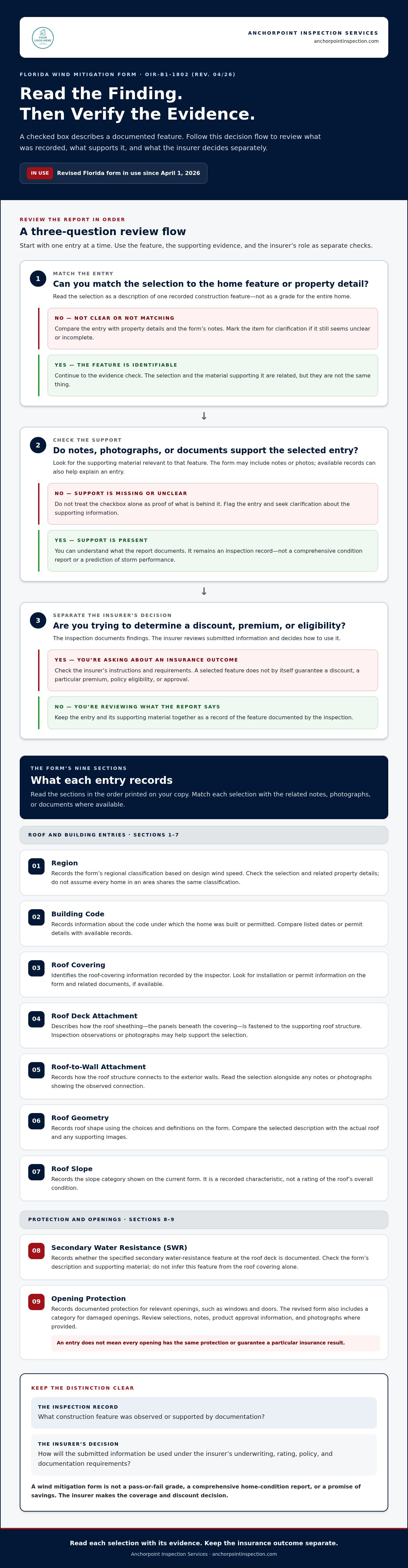
Use this comparison as you review:
If something doesn’t line up, identify the exact field and what seems unclear. For instance, ask what observation or document supports a particular selection. A specific question is easier to address than a general concern that the whole form may be wrong.
Separate inspection findings from insurance outcomes
The form records inspection findings. The insurer decides how to use the submitted information under its own underwriting and documentation processes. A favorable-looking checkbox doesn’t guarantee a specific discount, premium, policy eligibility, or acceptance of the report. Don’t treat the form as a savings estimate; the insurer’s decision depends on its review.
For broader context on how different property inspections fit into Florida insurance files, see the Florida home insurance inspection guide. Keeping the inspection evidence separate from the insurer’s decision helps you review each on its own terms and follow up calmly if a detail needs clarification.
A Practical Checklist for Reviewing Your Florida Wind Mitigation Form
A methodical review helps you catch mismatched details and prepare clear questions without relying on memory. Use the completed current form and its supporting materials as your reference. Homes in Bay County can differ in age, roof design, and documented upgrades, so don’t assume your home has a feature simply because a nearby property does.
Check the property details and inspection record first
Confirm the property. Compare the address and other identifying details on the form with the home covered by the insurance file. Note any spelling, unit, or address discrepancy.
Check the inspection record. Review the inspection date, inspector information, signature fields, and form version. The current Florida form is OIR-B1-1802 (Rev. 04/26). If your copy shows a different revision, don’t assume it’s automatically unusable; check the insurer’s instructions for that report.
Read each selected field in context. Review the option’s wording, then compare it with related comments, photographs, and documents provided. Base your understanding on what the report records, not on what you believe is behind a ceiling or under a roof covering.
Keep the file together. Store the completed form with its photographs, notes, and supporting records. Keeping the materials in one place makes it easier to refer to the same information if the insurer requests it.
Resolve unclear entries with focused follow-up
If an entry seems blank, inconsistent, or difficult to interpret, write down the exact section and wording. Then ask for clarification about the observation recorded and any available evidence supporting it. Instead of asking whether the whole form is correct, identify the specific roof feature or opening-protection entry you’re unsure about. A precise question gives everyone a clearer place to start.
If your question concerns the roof’s age rather than a wind-resistance feature, keep that issue distinct from the mitigation findings. A Florida roof certification inspection guide can provide context on roof certification and roof-age documentation.
Use these steps to understand what the report says, not to predict an insurance credit. Anchorpoint Inspection Services provides professional wind mitigation inspections for homes in Lynn Haven, Panama City, Panama City Beach, and surrounding Bay County communities. A clear inspection record helps organize information for review, while the insurer determines how it applies to your policy.
When a Professional Wind Mitigation Inspection Can Clarify the Form
A professional review can help if a form is incomplete, difficult to interpret, or based on information that may no longer reflect the home. Renovations, roof work, or changes to windows and doors can make older documentation less useful for describing current conditions. Before arranging an inspection or submitting a report, review your insurer’s instructions for form, documentation, or report-age requirements.
What a professional inspection adds to the review
A wind mitigation inspection focuses on documenting observable features related to wind resistance. The inspector records findings on the applicable Florida form and may include supporting notes or photographs to explain what was observed. This can make technical entries easier to understand and help you connect a checkbox with the feature it describes.
That documentation can help you understand the home and organize information for insurer review. It doesn’t guarantee that the insurer will accept a particular entry, approve coverage, or apply a discount. The insurer makes those determinations through its own review process.
If you’re still learning how to read a wind mitigation form, bring specific questions to the inspection process. Note which field seems unclear and whether a supporting photo or document is missing. A focused review can clarify what the report records without assuming what the insurer will decide.
Choose a calm next step for your home
If the form is complete and its entries make sense, follow the insurer’s stated submission process and keep a copy of the form and supporting materials. If a feature or entry remains unclear, a new or updated inspection can provide a clearer record of the home’s observable features.
Anchorpoint Inspection Services provides wind mitigation inspections in Lynn Haven, Panama City, Panama City Beach, and surrounding Bay County communities. The company also serves Callaway, Southport, Mexico Beach, Port St. Joe, Santa Rosa, Fort Walton, Niceville, Destin, Pensacola, Gulf Shores, and San Destin. Homes vary, so each inspection documents the features observed at that property rather than assuming they match a neighbor’s.
Review Your Form With Confidence and Take the Next Step
Knowing how to read a wind mitigation form starts with separating documented home features from the insurer’s decision. Review each selection alongside its notes and supporting materials, and check that the property and inspection details match your records. If an entry is unclear or the report may not reflect current features, write down your question and seek clarification rather than making assumptions.
A professional wind mitigation inspection can provide a clear record of observable features, but it can’t guarantee an insurance credit, premium, or policy outcome. Anchorpoint Inspection Services provides wind mitigation inspections in Lynn Haven, Panama City, and surrounding Bay County communities. The business is owned and operated by John R. Gramlick III, a Florida-licensed home inspector.
A thoughtful review can help you understand the report and move forward with confidence.
Frequently Asked Questions
What is a Florida wind mitigation form?
A Florida wind mitigation form is an inspection document that records features of a home related to wind resistance. The current form is the Uniform Mitigation Verification Inspection Form, OIR-B1-1802 (Rev. 04/26). It organizes observations about items such as roof covering, roof-to-wall attachment, roof geometry, and opening protection. The form documents findings; it doesn’t independently set your insurance premium or guarantee a credit.
How do I read a wind mitigation form?
Start by confirming the property details and checking that you have the applicable form version. Then review each section in order, comparing selected options with the written notes and available photographs or documents. Pay close attention to roof connections, roof shape, secondary water resistance, and opening protection. If an entry seems unclear or inconsistent, note the exact field and ask for an explanation rather than guessing what it means.
Does a wind mitigation form guarantee an insurance discount?
No. A completed form records inspection findings, but it doesn’t guarantee a discount, a particular premium, or policy approval. Insurers review submitted information under their own underwriting and documentation processes, so a checkbox alone isn’t a reliable way to estimate savings. Ask your insurer how it evaluates the form and whether it needs additional or updated documentation. Keep the inspection result separate from the insurer’s decision.
What sections are on a wind mitigation form?
Check the current Florida form for its exact section labels and order. Categories include roof covering, roof deck attachment, roof-to-wall attachment, roof geometry, secondary water resistance, and opening protection. Each records a different feature, and the selection should be read alongside relevant notes and supporting evidence. Use the completed report and its materials to interpret the entries, since not every home or form version presents information identically.
Can I submit an old wind mitigation form to my insurer?
Acceptance depends on the insurer’s requirements and the report’s age, so there isn’t one answer for every policy. Review the insurer’s current instructions before submitting an older form. Confirm that the property details remain accurate and check whether the form version is acceptable. If updated documentation is requested, arrange an inspection using the applicable current form and keep the supporting materials with your copy.
What should I do if information on my wind mitigation form looks wrong?
Identify the specific section and entry that concerns you before deciding what to do next. Compare it with the report’s notes and available supporting materials, then request clarification about the observation recorded. If the home has changed or the evidence appears incomplete, an updated inspection may provide a clearer record. Keep questions about what the inspector observed separate from the insurer’s requirements for reviewing or accepting the document.
Is a wind mitigation inspection the same as a 4-point inspection?
No. A wind mitigation inspection documents selected wind-resistant construction features, while a 4-point inspection focuses on specified major home systems. An insurer may request one or both, depending on its requirements, so review each report separately. For more context, see the Florida home insurance inspection guide. Anchorpoint serves Lynn Haven, Panama City, Panama City Beach, and surrounding Bay County communities.
For a clear record of your home’s observable wind-resistant features, schedule a wind mitigation inspection with Anchorpoint Inspection Services.
Comments