

Wind Mitigation Inspection Lynn Haven: Your 2026 Guide to Lowering Insurance Premiums
In Florida, the windstorm portion of your homeowner's insurance can account for up to 70% of your total premium, depending on your home's proximity to the coast. If you've watched your annual bill climb higher every year in Lynn Haven, you aren't alone. It's a stressful situation that leaves many homeowners feeling like they're paying for protection they can't quite control. A professional wind mitigation inspection Lynn Haven is the most effective tool you have to reclaim that control and lower those costs.
This 2026 guide explains how the updated OIR-B1-1802 form works and why your roof-to-wall attachments matter more than ever. We'll walk through the specific features that trigger insurance credits, the differences between this and a 4-point inspection, and how to prepare your property for the new 2026 standards. By the end, you'll have a clear path to both a more resilient home and a more manageable insurance budget. Understanding these requirements doesn't have to be overwhelming; it's simply the first step in protecting your investment and your peace of mind.
Table of Contents
Understanding Wind Mitigation Inspections in Lynn Haven (2026)
A Windstorm inspection is a specialized structural audit designed to evaluate how well your home can withstand the powerful forces of a hurricane or tropical storm. Unlike a general home inspection that looks at the overall condition of a property, this process focuses on specific construction features that prevent wind from lifting your roof or pushing in your windows. In our coastal environment, a wind mitigation inspection Lynn Haven is a strategic financial tool. It provides the documented proof your insurance carrier needs to lower your premiums based on the actual strength of your home.
Florida law recognizes that hardened homes are less likely to result in costly claims. Under Florida Statute §627.711, insurance companies are legally mandated to provide premium credits to homeowners who have documented mitigation features. This isn't an optional "perk" offered by insurers; it's a state requirement designed to encourage property owners to protect their investments. For Lynn Haven residents facing rising insurance costs, this inspection is often the most direct way to see an immediate reduction in annual expenses.
The Role of the OIR-B1-1802 Form
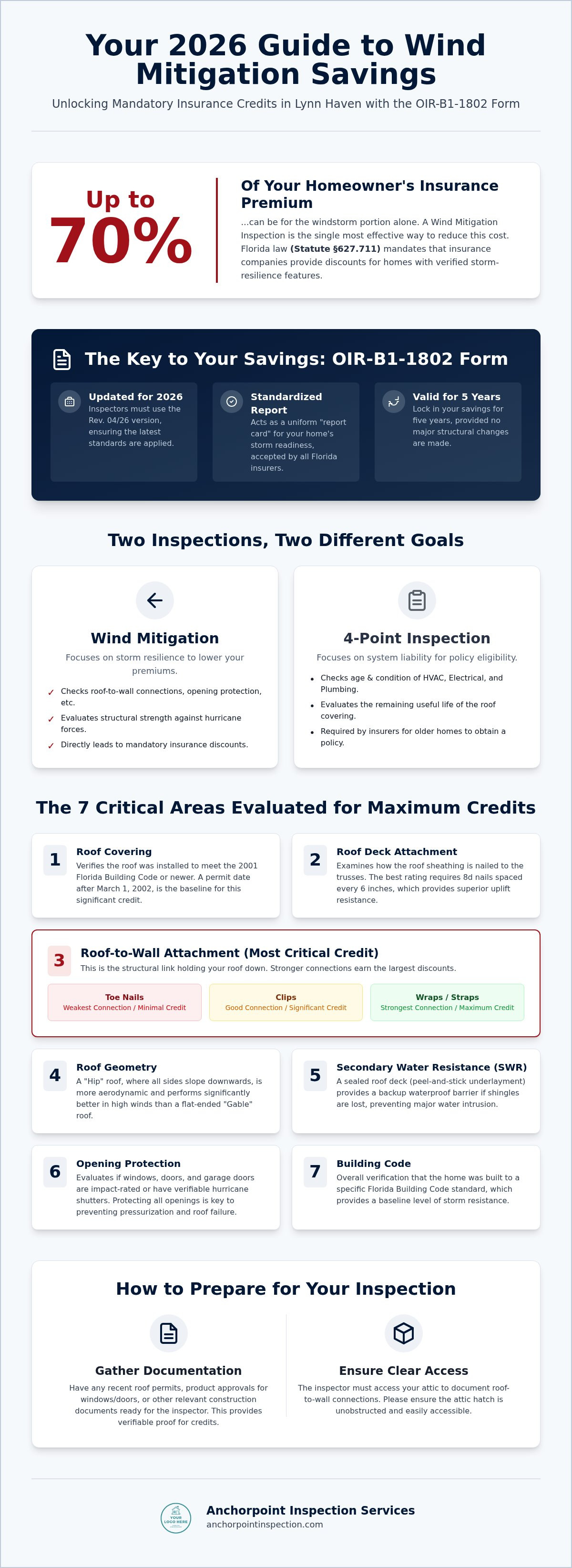
When your insurance agent asks for a "wind mit," they're specifically looking for the Florida Office of Insurance Regulation (OIR) form B1-1802. As of April 1, 2026, all inspectors must use the updated Rev. 04/26 version of this form. This document acts as a standardized report card for your home's storm readiness. It covers everything from the age of your roof deck to the specific type of nails used in your rafters. Once completed by a licensed professional, the report remains valid for five years, provided you don't make significant structural changes to the home. This five-year window allows you to lock in your credits and provides a predictable path for your insurance planning.
Wind Mitigation vs. 4-Point Inspections
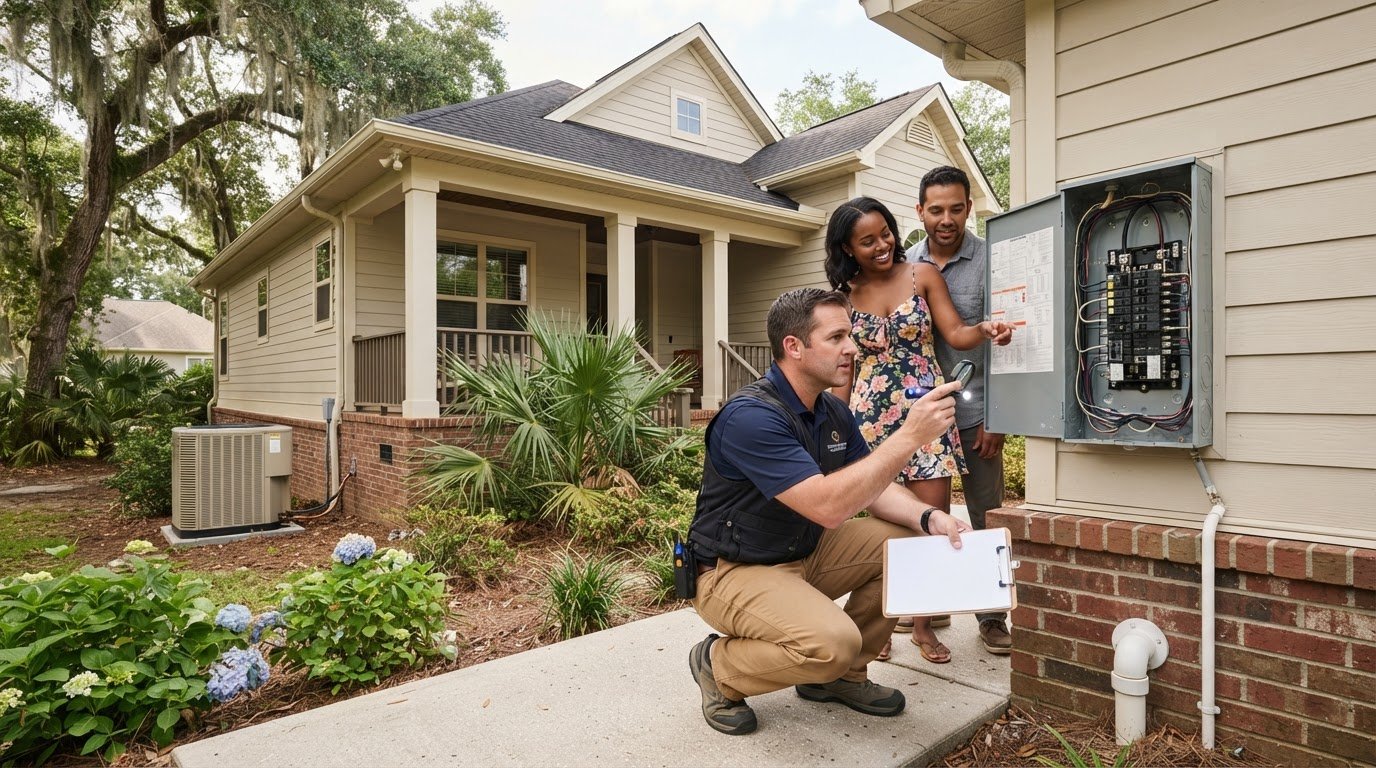
Confusion often arises when homeowners are asked for multiple reports during a policy renewal. It's helpful to think of these as two different lenses through which an insurer views your property. A 4-point inspection evaluates the current health and remaining life of your HVAC, electrical, plumbing, and roofing systems to ensure they aren't a liability. Conversely, a wind mitigation inspection Lynn Haven is strictly about storm resilience. It doesn't care if your sink leaks; it cares if your roof will stay attached when the wind hits 130 mph. You can learn more about how these reports complement each other in our guide on 4 Point Inspection vs Wind Mitigation: Key Differences. In many cases, Lynn Haven homeowners with older properties will need both to satisfy underwriting requirements and secure the best possible rates.
The 7 Key Areas of a Florida Wind Mitigation Report
The official Uniform Mitigation Verification Inspection Form (OIR-B1-1802) updated for 2026 serves as a technical checklist for your home's structural integrity. During a wind mitigation inspection Lynn Haven, your inspector evaluates seven specific categories that define how well your property can resist wind pressure and water intrusion. These aren't just checkboxes; they're data points that tell your insurance company how much risk they're actually taking on.
Roof Covering: We verify the age and permit date of your roof. For the best credits, the roof must comply with the 2001 Florida Building Code (or later). If your roof was permitted after March 1, 2002, you're likely meeting this baseline.
Roof Deck Attachment: This looks at how your roof's plywood or OSB is fastened to the rafters. We look for 8d nails spaced every six inches. If your builder used staples or shorter nails, your credit may be lower.
Roof-to-Wall Attachment: This is the most critical structural link. We document whether your roof is held down by toe-nails, clips, or "wraps" that literally tie the roof to the wall's structure.
Roof Geometry: The shape of your roof matters. A "Hip" roof, which slopes down on all sides like a pyramid, is much better at deflecting wind than a "Gable" roof with flat ends. In Bay County, hip roofs typically earn the highest available geometry credits.
Secondary Water Resistance (SWR)
A "sealed roof deck" is a modern standard that provides a second line of defense. If a hurricane strips away your shingles, SWR prevents water from pouring through the gaps in your plywood and destroying your home's interior. In 2026, many carriers are looking for specific self-adhering polymer modified bitumen or "taped" seams. We verify this by looking for specific markings in your attic space or reviewing your roofing contractor's documentation. If you're unsure if your recent roof upgrade included this, consulting with an expert before your next renewal can provide the clarity you need.
Opening Protection: Windows and Doors
Opening protection is an "all or nothing" category for insurance credits. To receive this discount, every single opening—including windows, skylights, entry doors, and even glass blocks—must be impact-rated or protected by approved shutters. We also verify the wind rating of your garage door. In high-wind events, a garage door failure can lead to a massive change in internal pressure, which is a leading cause of roof failure. We look for NAMI or NOA certifications to ensure your protections meet current Florida standards.
Calculating Your Potential Insurance Savings in Bay County
Investing in a wind mitigation inspection Lynn Haven is one of the few home maintenance tasks that offers a direct, quantifiable return on investment. While insurance rates in Bay County are influenced by many factors, the credits earned from a professional report often range from $100 to over $1,000 in annual premium reductions. Because the windstorm portion of your policy can represent 15% to 70% of your total cost, even a 30% discount on that portion leads to substantial long-term savings. In most cases, the one-time fee for the inspection pays for itself within the first year of your policy renewal.
The "Roof-to-Wall" attachment is frequently the single most significant factor in these calculations. If your home was built after the 2001 Florida Building Code took effect in March 2002, your property naturally qualifies for higher baseline credits because modern standards required more robust fastening methods. However, older homes can still achieve these high-tier discounts through documented verification of clips or wraps. According to Florida's official wind mitigation resources, insurers are required to provide these discounts when the structural components meet specific safety thresholds.
The "Hip Roof" Advantage
The geometry of your home plays a silent but powerful role in your monthly expenses. Insurance carriers favor "Hip" roofs because their aerodynamic shape allows wind to flow over the structure rather than pushing against a flat surface. To qualify for the maximum geometry credit, the measurement standard requires that the hip roof perimeter is at least 90% of the total roof system perimeter. This structural efficiency translates directly into lower risk for the insurer and lower premiums for you. If your home features a mix of roof shapes, we carefully measure the perimeter to ensure you receive every percentage of credit you're entitled to.
Retrofitting for Credits
If your current report shows you're missing out on credits due to "toe-nail" attachments, you don't necessarily have to wait for a full roof replacement to improve your status. Retrofitting your home with hurricane clips or adding a third nail to existing straps can often bump your home into a higher discount bracket. It's also vital to update your report immediately following any major work. A new roof permitted under the current 8th Edition Florida Building Code will almost certainly improve your mitigation standing. For more detail on how a new roof impacts your coverage, see our 2026 Florida Roof Inspection Guide for Insurance. Taking these proactive steps ensures your insurance agent has the most current data to advocate for your lower rate.
How to Prepare Your Home for a Wind Mitigation Inspection
Preparing for a wind mitigation inspection Lynn Haven is less about cleaning and more about providing clear evidence. We don't need your home to be spotless, but we do need access to the structural components that prove your home's strength. The most critical area is your attic hatch. Please ensure there's a clear path to the access point and that the space underneath is free of furniture or storage. During the "Attic Walkthrough," we must physically get into the space to photograph the roof-to-wall connections and the roof deck fastening. If we can't see the clips or the nail spacing, we can't document them for your insurance credits.
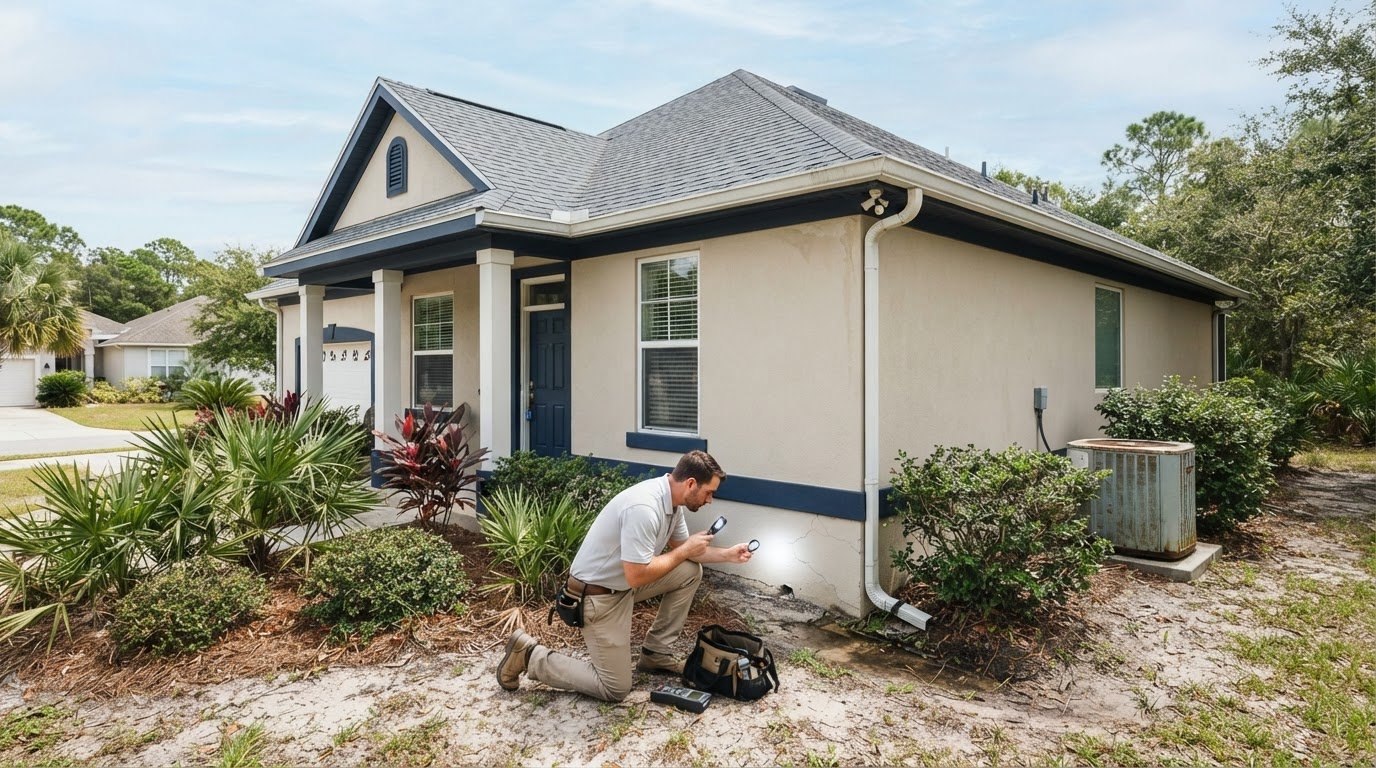
Beyond the attic, we'll need to walk the entire perimeter of your home. Ensure all windows and doors are accessible and that any hurricane shutters are easily reached. If you have removable panels, having one or two out for us to inspect the labels and mounting hardware can save significant time. Documentation is the backbone of a successful report. Gathering your records beforehand ensures we have the specific permit numbers and product certifications required by the OIR-B1-1802 form. This proactive step helps us build the strongest possible case for your premium reductions.
Documenting Your Protection
If you've recently replaced your roof, we need the permit date to verify it meets the current building code. You can find this information on the Bay County Property Appraiser website or the local building department portal. For shutters or impact windows, look for the "Notice of Acceptance" (NOA) or NAMI certifications. These documents prove the products were tested for high-wind performance. If you don't have the original paperwork, don't worry. We can often find the necessary codes on the product labels located in the window tracks or on the door hinges. If these labels are painted over or removed, it becomes much harder to verify the rating.
Common Fail Points to Avoid
Even a well-built home can miss out on credits due to small, overlooked details. In many older Lynn Haven neighborhoods, the garage door is a frequent fail point because it lacks a modern wind-load rating. Another common issue is the "missing nail" in a hurricane clip. Florida standards often require three nails to qualify for the highest credit; if only two were installed, the discount drops significantly. Finally, remember that opening protection is all-or-nothing. If you have impact windows for every opening except one small bathroom window, the insurance carrier will likely deny the entire protection credit. If you're ready to document your home's safety and start saving, schedule your wind mitigation inspection today to ensure every credit is accurately captured.
Why Anchorpoint is Lynn Havens Choice for Accurate Wind Reports
Anchorpoint Inspection Services, led by John R. Gramlick III, brings a deep understanding of Bay County’s unique construction standards to every wind mitigation inspection Lynn Haven homeowners request. We don't just fill out a form and leave; we act as a diligent mentor throughout the process. This means we take the time to explain exactly how your home’s specific features, like its roof-to-wall attachments or secondary water resistance, translate into the credits on your OIR-B1-1802 report. Our goal is to empower you with the knowledge needed to have a productive conversation with your insurance agent.
We understand that insurance renewal windows are often tight. A delay in receiving your report can mean missing out on savings for an entire billing cycle. Because of this, we prioritize fast turnaround times without sacrificing the accuracy that prevents your credits from being questioned or denied by underwriters. Our comprehensive approach also allows you to bundle services, such as combining your storm resilience check with an Expert Pool Inspection in Lynn Haven. This ensures every part of your property is evaluated by a professional who cares about your family’s long-term well-being and financial health.
The Anchorpoint Process
Our methodical workflow begins the moment you book your appointment. We move through a structured physical walkthrough of your property, documenting everything from the nail spacing in your roof deck to the ratings on your opening protections. Once the site visit is complete, we translate those observations into a clear, digital report delivered directly to your inbox. We focus on absolute accuracy because even a single missing photo or permit date can lead to a rejected credit. By providing a thorough and transparent report, we help Lynn Haven families protect their largest investment from both physical storms and rising financial costs.
Ready to Lower Your Premiums?
Taking action today can lead to significant annual savings on your Florida homeowners insurance. Whether you live in the heart of Lynn Haven or in the surrounding areas of Panama City and the Beaches, Anchorpoint is your local partner in storm resilience. We're here to provide the clarity and professional documentation you need to manage your insurance costs effectively. If you're ready to see how your home’s safety features can work for your budget, contact us to schedule your wind mitigation inspection Lynn Haven. Let's work together to secure your home and your peace of mind.
Securing Your Home and Your Budget for 2026
A professional wind mitigation inspection Lynn Haven is more than a required document; it's a strategic investment in your home’s financial and physical resilience. By documenting your roof's age, its geometry, and the strength of its attachments using the updated OIR-B1-1802 form, you provide your insurance carrier with the proof needed to apply mandatory premium credits. These savings often pay for the inspection itself in the first year, making it a proactive step toward managing the rising costs of Florida homeownership while ensuring your property is prepared for storm season.
At Anchorpoint Inspection Services, we take our role as your diligent mentor seriously. John R. Gramlick III, a Florida Licensed Home Inspector, brings local expertise to every assessment, ensuring your report is accurate and your credits are secure. We're committed to helping you understand the reasoning behind your home's storm ratings so you can move forward with clarity and confidence. Schedule Your Lynn Haven Wind Mitigation Inspection with Anchorpoint Today and take the first step toward a safer, more affordable future. Protecting your investment starts with professional documentation you can trust.
Frequently Asked Questions
How long does a wind mitigation inspection take in Lynn Haven?
A standard wind mitigation inspection Lynn Haven typically takes between 30 and 60 minutes to complete. The duration depends on your home's size and how easily your inspector can access the attic. During this time, we focus on documenting structural connections and photographing the roof deck. Having your attic hatch clear and your paperwork ready helps us move through the process efficiently and ensures we capture every detail required for your insurance report.
Will a wind mitigation inspection ever increase my insurance rates?
No, a wind mitigation inspection is designed specifically to identify discounts and won't increase your insurance premiums. In Florida, these reports verify safety features that reduce risk for the insurer. If your home lacks certain features, you simply won't receive those specific credits. It's a low-risk assessment where the only outcome is either maintaining your current rate or discovering new ways to lower your annual costs through structural improvements.
Do I need a new wind mitigation report every year in Florida?
You don't need a new report every year; a wind mitigation report is valid for five years from the inspection date under Florida law. However, you should schedule a new wind mitigation inspection Lynn Haven if you replace your roof or upgrade your window protection before that five-year window closes. Updating your report after structural improvements ensures your insurance agent can apply the most current and highest possible credits to your policy immediately.
What is the most important feature for a wind mitigation credit?
The roof-to-wall attachment is the most impactful feature for insurance savings in Bay County. This connection determines how well your roof stays anchored to the walls during high-wind events. Credits scale upward from basic toe-nails to more secure clips and wraps. Because this feature significantly reduces the risk of catastrophic roof failure, insurance carriers often weight this category more heavily than others when calculating your final premium discount and overall risk level.
Can I perform my own wind mitigation inspection?
You cannot perform your own inspection for insurance purposes. Florida insurance carriers only accept the OIR-B1-1802 form when it's completed and signed by a licensed professional, such as a Florida Licensed Home Inspector. These experts have the technical training to identify specific fastener types and building code compliance. Using a certified professional like Anchorpoint ensures your report meets the strict 2026 documentation standards required for your credits to be approved by your carrier.
What if my home was built before 2001?
Homes built before the 2001 Florida Building Code took effect are still eligible for significant credits. While newer homes often have these features built-in, older Lynn Haven properties can be retrofitted with hurricane clips, secondary water barriers, or impact-rated shutters. An inspection will document your current status and help you identify which specific upgrades would offer the best return on investment for both your home's storm safety and your annual insurance budget.
How much can I actually save with a wind mitigation report in 2026?
Savings vary by carrier, but Florida homeowners often see annual premium reductions ranging from $100 to over $1,000. In many cases, a favorable report can reduce the windstorm portion of your premium by up to 30%. Since this portion of your policy can account for a large percentage of your total bill in coastal areas like Panama City, the financial benefit of a documented inspection is often substantial and immediate upon your next renewal.
What is the difference between a hurricane strap and a clip?
The primary difference lies in how they secure the roof rafter to the wall. A hurricane clip is a metal plate that attaches to the side of the rafter with at least three nails. A strap, or "wrap," is a longer metal piece that physically wraps over the top of the rafter and is secured on both sides. Both provide better protection than simple toe-nails, but wraps generally qualify for higher insurance credits due to their superior strength.
Comments