

Pool Safety Barrier Inspection in Lynn Haven: What Gets Checked
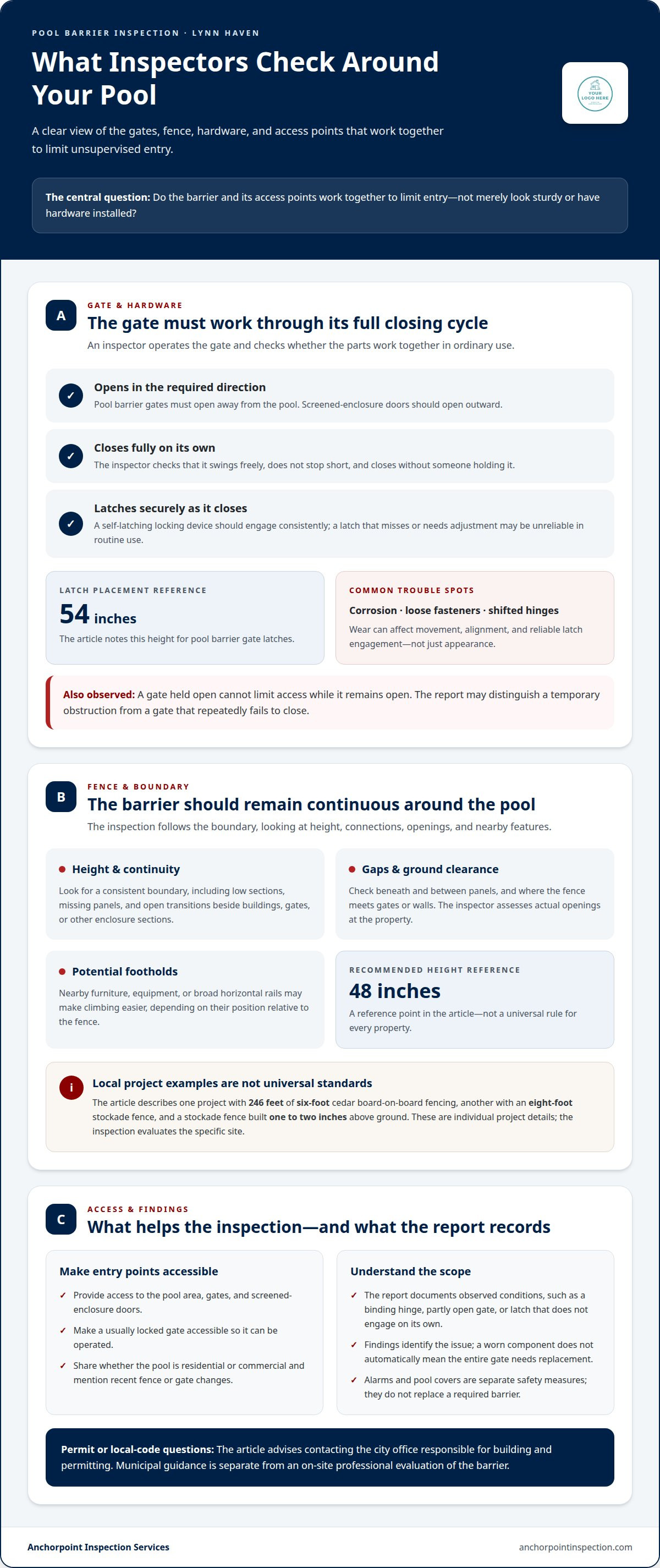
A pool safety barrier inspection in Lynn Haven evaluates whether the fence, gates, latches, and nearby enclosure openings work together to limit unsupervised access. According to the Florida Legislature, pool gates must open away from the pool, close themselves, and have a self-latching locking device. The inspection also considers latch placement, including the 54-inch height noted for pool barrier gates.
A barrier can look sturdy while a gate that will not close properly or a damaged section creates a weak point. Knowing what a pool safety barrier inspection in Lynn Haven covers can clarify the process and help you understand which findings may need attention. This article explains how inspectors assess gates and hardware, fence condition, and potential climbing features, as well as how residential and commercial properties may differ. You’ll also learn what information can help the inspection proceed smoothly and how Anchorpoint Inspection Services’ Pool & Spa Inspection can help you evaluate your property’s pool area.
Table of Contents
What does a pool compliance inspection evaluate?
A pool compliance inspection evaluates whether the barrier and its access points limit entry to the swimming pool. The inspector examines the gate, latch, hinges, closing action, fence condition, and openings between sections. Pool barrier gates have a latch height of 54 inches. According to the Florida Legislature, gates must open away from the pool, close themselves, and have a self-latching locking device. The inspection considers whether these features work together, not just whether hardware is present.
Gate performance is assessed by operating the gate. The inspector checks whether it swings freely, closes fully on its own, and engages its latch. A gate that stops short or misses the latch may not function as intended. Screened enclosures need attention too: doors should open outward, self-close, and self-latch. Hinge condition, alignment, and latch engagement all affect closing. The inspection also considers whether a door or gate can remain unsecured during ordinary use.
If a barrier inspection in Lynn Haven identifies a deficiency, the report documents the observed condition so you can address it. The appropriate next step depends on the finding and whether the inspection is connected to a permit or another approval process. Do not assume an alarm or pool cover replaces a required barrier. Alarms and covers are separate safety measures; the barrier assessment focuses on the fence, gate, and access points.
To schedule an inspection, arrange an appointment with Anchorpoint Inspection Services and explain that you want the pool barrier evaluated. Provide the property address and arrange access to the pool area, gates, and screened-enclosure doors. Clear access allows the inspector to operate each entry point and assess how it closes and latches. If a gate is usually locked, make it accessible during the appointment.
For questions about Lynn Haven permits or local code interpretation, contact the city office responsible for building and permitting. Municipal guidance is separate from a professional’s on-site evaluation of the barrier. When arranging the inspection, describe whether the pool is residential or commercial and mention any recent fence or gate changes. This context helps explain the property without replacing an on-site assessment.
Common deficiencies such as propped-open gates and corroded hardware
During a pool safety barrier inspection in Lynn Haven, the inspector considers how normal use affects the gate and its hardware. A gate held open for convenience cannot limit access while it remains open. The inspector may note whether it swings freely, closes fully, and stays secured without someone holding it. The report can distinguish a temporary obstruction from a gate that repeatedly fails to close properly.
Hardware wear can affect function as well as appearance. Corrosion, loose fasteners, or a shifted hinge may interfere with latch alignment and movement. The inspection considers how these parts work together, including whether the latch engages consistently as the gate closes. A component that catches only when pressed or adjusted may be unreliable in routine use, even if it looks intact at first glance.
A pool safety barrier inspection in Lynn Haven can document how a deficiency affects access. For example, the inspector may describe a gate that remains partly open, a hinge that binds, or a latch that fails to engage on its own. Specific observations help you understand which part needs attention and why, without assuming that every worn component requires a full gate replacement.
Findings can help focus maintenance on the actual issue. A loose hinge may call for attention to its attachment, while a damaged latch may require a different repair decision. The inspection records observed conditions rather than prescribing work beyond its scope. For owners reviewing other major property systems, a 4-Point Inspection addresses a separate set of components.
Fence height, continuity, gaps, and climbable features
An inspection follows the barrier around the swimming pool, checking its height, connected sections, openings, and nearby objects. A 48-inch-high barrier is a recommended reference, while the full layout and each transition also matter.
Fence Height and Continuity
The inspector assesses whether the barrier maintains a consistent height and forms a continuous boundary around the pool area. A low section, missing panel, or open transition beside a building can interrupt that boundary. The inspection also considers how the fence meets gates and other enclosure sections. A fence may appear tall at the front while having a lower or disconnected section elsewhere.
Lynn Haven projects illustrate why a single fence design should not be mistaken for a universal standard. A 2025 project used 246 feet of six-foot cedar board-on-board fencing; another used an eight-foot-high stockade fence. Those examples describe individual projects, not a rule that every property must copy. The inspection evaluates the barrier at the specific site.
Gaps and Climbable Features
Inspectors look for openings beneath or between fence sections and at junctions with gates or walls. A visible gap can affect how well the barrier separates the pool from surrounding areas. The inspector also considers potential footholds, such as nearby furniture, equipment, or broad horizontal rails. Their position relative to the fence can affect how easily someone might climb over it.
Ground clearance deserves attention because a fence may appear continuous while leaving space below its panels. A 2025 Lynn Haven stockade fence project was built one to two inches above the ground, but that project detail alone does not establish a universal clearance rule. Inspectors assess the actual condition and location of gaps rather than relying on another property’s measurements.
Gate openings are part of this review, too. A ten-foot double gate appeared in a 2025 Lynn Haven fence project, showing how wider access points can form part of a barrier layout. The inspector considers whether the surrounding fence remains continuous when the gate is closed and whether its edges leave openings that undermine the boundary.
Residential and commercial compliance requirements
Residential and commercial pool properties share a practical concern: barriers and safety equipment must suit the pool’s setting and use. Whether Lynn Haven requires a fence permit depends on local government requirements. Permitting is separate from what a professional inspection evaluates, so the property’s purpose and any planned work provide useful context.
At a residential property, the assessment considers how the pool area connects to the home and other accessible spaces. A gate leading from a patio, for example, creates a different access point from a fence enclosing a detached pool. At a commercial property, the inspector also considers how the barrier relates to the site layout and routine access. These details help describe conditions without assuming identical requirements for every property.
Florida’s local requirements can include protective measures beyond a fence. Most Florida municipalities require one form of protective device for children and elderly people. Consider the relevant device and its condition alongside the pool barrier, rather than treating one feature as the whole safety picture.
Pool equipment changes over time, too. Drain covers that met anti-entrapment requirements ten years ago may no longer meet current requirements. An assessment can document the cover’s condition and whether it matches the pool sump configuration. This matters in both residential and commercial settings because equipment fit is relevant regardless of how the property is used.
Annual pool compliance inspections are recommended to assess whether barriers, drain covers, and safety equipment remain compliant. For a commercial site, changes in access or operations may make a fresh review useful; for a residence, fence or equipment changes can prompt one. A professional pool inspection can document visible conditions and help owners understand findings. Arrange a pool inspection to have a property’s pool area evaluated.
Whether a fence permit is required depends on Lynn Haven’s local requirements. Annual pool compliance inspections are recommended to assess barriers and related safety equipment, but they are not described as mandatory.
Anchorpoint Inspection Services: Pool Inspection
Anchorpoint Inspection Services provides a Pool & Spa Inspection for owners who want a professional evaluation of their pool area. It can help when you’re assessing barrier condition, reviewing gate or fence concerns, or considering property changes. The inspection documents observed conditions and identifies points that may need attention.
For a broader property review, a Comprehensive Home Inspection can assess the home alongside the pool. A Wind Mitigation Inspection or 4-Point Inspection addresses different property needs, including insurance-related evaluations.
To discuss a pool evaluation, contact Anchorpoint Inspection Services.
Make Your Next Property Decision With Clarity
A pool safety barrier inspection in Lynn Haven can give you a clearer basis for planning maintenance, renovations, or future property decisions. Use the findings as practical information to prioritize attention and keep a record of the pool area’s condition as it changes.
If you’re also assessing the wider property, Anchorpoint Inspection Services offers a Comprehensive Home Inspection, Wind Mitigation Inspection, and 4-Point Inspection. Each addresses a different inspection need, so you can consider the service that matches your current plans.
A professional evaluation is a useful step when you want an informed view of the pool area, whether you’re maintaining a home or managing a property. Contact Anchorpoint Inspection Services to discuss your inspection needs and choose a clear next step with confidence.
Frequently Asked Questions
What are Lynn Haven, Florida's pool barrier requirements?
Pool gates must open away from the pool, close themselves, and have a self-latching locking device, according to the Florida Legislature. Pool barrier gates should also have latches at least 54 inches high. For a Lynn Haven property, the inspection considers how the barrier works as a whole, including fence continuity and access points. Permit needs depend on local government requirements.
What Florida building code rules apply to residential pool safety barriers?
For residential pools, the specific gate rule provided by the Florida Legislature requires gates to open away from the pool, close automatically, and use a self-latching locking device. The latch height noted for pool barrier gates is at least 54 inches. These points help frame a property review, while the applicable requirements depend on the project and local permitting context.
What are the required pool fence height, gate, and latch specifications in Lynn Haven?
The available specifications include a recommended 48-inch-high barrier and pool gate latches at least 54 inches high. The Florida Legislature states that gates must open away from the pool, close themselves, and have a self-latching locking device. Check local requirements before treating a recommended barrier height as a required minimum. Permit requirements depend on local government rules.
What common pool barrier violations do inspectors find in Florida?
Common problems include gates held open, latches that fail to catch, corroded or loose hardware, and damaged fence sections. For example, a latch may be present but miss its strike plate because the gate has shifted. Inspectors may also note openings or nearby objects that make the barrier easier to climb. These observations identify conditions you can address.
Comments