

2026 Guide to Florida Home Insurance Inspections
If you think your homeowners policy is a fixed cost, you might be overlooking the most powerful tool in your financial arsenal. In a market where Florida consistently has some of the highest average insurance costs in the country, an insurance inspection Florida home owners prioritize can be the difference between a manageable bill and a non-renewal notice. We understand that opening your renewal package often feels like bracing for impact. It's frustrating to face technical requirements while feeling confused about which forms or certifications your carrier actually needs to keep your coverage intact.
Our goal is to help you manage these complexities with a clear, step-by-step approach. You'll learn exactly how to use specific inspections to secure your policy and potentially lower your premiums through documented credits. We will walk through the updated 2026 wind mitigation requirements, including the mandatory OIR-B1-1802 form, and explain how the 4-point inspection process protects your home's eligibility. By the end of this guide, you'll have a practical roadmap for optimizing your home's insurance profile and maintaining the long-term health of your property.
Table of Contents
Understanding the Florida Insurance Market and Inspection Requirements
An insurance inspection Florida home carriers require is fundamentally different from the comprehensive report you receive when buying a house. While a buyer's inspection focuses on every cosmetic detail and minor repair, an insurance-focused report is a targeted tool designed for risk mitigation. It provides a snapshot of your home's most critical systems to help underwriters determine if the property meets their safety standards. Instead of looking at the color of the paint or the quality of the carpet, these reports focus on the age and condition of the components that could lead to a major claim.
In 2026, these reports are often the only bridge between a policy renewal and a cancellation notice. Some inspections are mandatory, such as a 4-point report for homes reaching a certain age, while others, like a Windstorm Inspection, are voluntary. These voluntary reports are strategic investments that can lead to significant premium credits by proving your home is hardened against the elements. Homeowners in Lynn Haven and Panama City face specific insurance hurdles because their coastal exposure demands a more robust approach to structural protection and documentation.
Why 2026 is a Turning Point for Florida Homeowners
The current market is showing signs of stabilization after years of volatility. Recent legislative updates in 2026 have introduced more rigorous documentation standards to combat fraud, making the accuracy of your insurance inspection Florida home report more critical than ever. Carriers now require more substantial evidence of system upgrades before they'll offer or renew a policy. Being proactive with an assessment before your renewal date prevents last-minute scrambles. It's about managing your risk profile before a carrier makes the decision for you.
The Role of Local Expertise in Bay County
Building codes in the Panhandle have evolved significantly, particularly following the lessons learned from major weather events. A local inspector understands these nuances better than a statewide firm because they see the real-world performance of local structures every day. We recognize that every street in Panama City and Lynn Haven has its own history of maintenance and upgrades. At Anchorpoint, we serve our neighbors by providing reports that reflect the specific underwriting preferences of carriers active in Bay County. We don't just provide raw data; we help you understand how your home's specific history impacts your coverage options today.
The 3 Critical Insurance Inspections Every Homeowner Needs
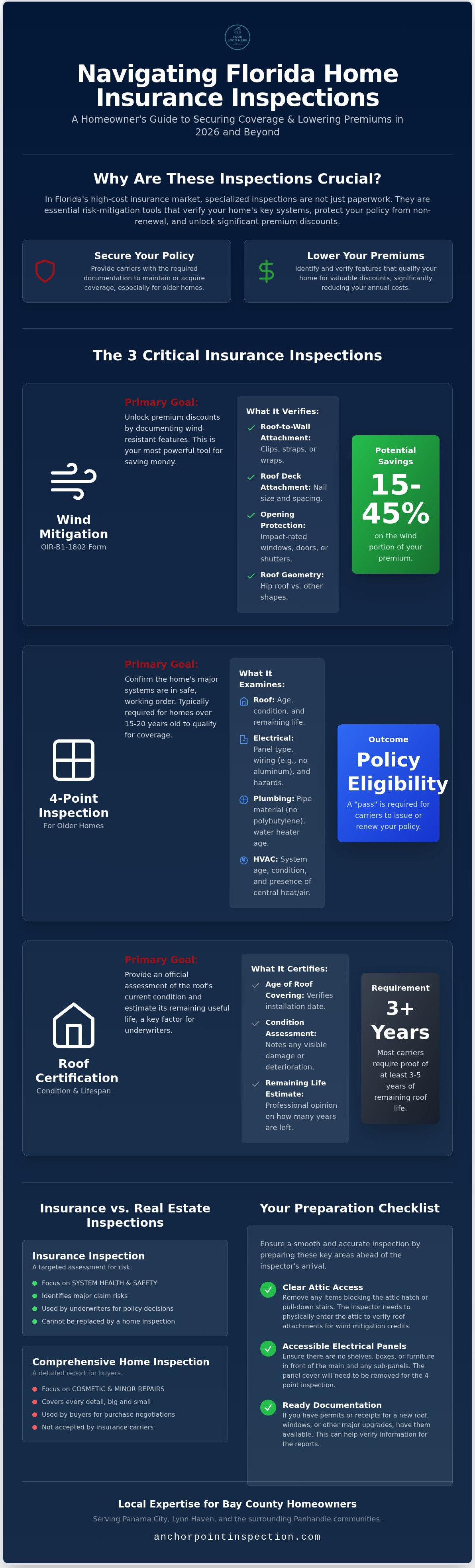
A comprehensive risk profile is built from three specific reports. While they overlap in some areas, each serves a distinct purpose for your insurance carrier. When these documents are bundled together, they provide a clear narrative of your home's resilience and system health. This transparency is exactly what an insurance inspection Florida home carriers look for when calculating your annual premium and determining your eligibility for coverage.
4-Point Inspection: The Standard for Older Homes
If your home was built more than 15 to 20 years ago, your insurance company will likely require a 4-point inspection before issuing a new policy or renewing an existing one. This report focuses on the four systems most likely to fail and cause a significant claim: the roof, electrical, plumbing, and HVAC. Inspectors look for specific hazards, such as outdated electrical panels, polybutylene piping, or aging water heaters. To understand the specific requirements for our area, you can review our guide on a 4-point inspection in Bay County, FL. It's a straightforward way to ensure your major systems meet current underwriting standards without any surprises during the renewal process.
Wind Mitigation: Your Ticket to Premium Discounts
The wind mitigation report is the most effective tool for lowering your monthly costs. It documents features that help your home withstand high winds, such as roof-to-wall attachments like clips or straps, specific nail spacing on roof decking, and opening protection like shutters. Homeowners often see savings between 15% and 45% on the wind portion of their premiums with a favorable report. You might also find additional resources through the My Safe Florida Home program, which provides grants for these types of hardening upgrades. For a closer look at the credits available to you, check out our wind mitigation inspection in Panama City guide. These inspections are generally valid for five years unless you replace your roof or upgrade your windows.
Roof Certification: Avoiding the Renewal Cliff
Insurance carriers in Florida are increasingly strict about roof age, often requiring a specific certification if a roof is approaching the end of its expected lifespan. While 2026 legislation protects roofs less than 15 years old from being the sole reason for non-renewal, a professional certification provides the evidence needed to maintain coverage on older structures. The inspector verifies the remaining useful life of the material and confirms there are no active leaks. If the inspector finds less than three years of life remaining, it's a signal that a replacement is necessary to keep your policy active. Understanding these requirements helps you plan maintenance proactively rather than reacting to a sudden carrier demand. If you're unsure about your current roof status, scheduling a professional assessment is a logical first step toward securing your home's future.
Comparing Insurance Inspections vs. Comprehensive Home Inspections
Choosing between different types of assessments often causes confusion for homeowners. It's vital to understand that an insurance inspection Florida home carriers mandate is a specialized document focused on high-level risks; conversely, a comprehensive home inspection is an exhaustive deep dive into every corner of the property. While a real estate report might span 50 pages and include details on chipped tile or a slow-draining sink, an insurance underwriter only cares about the major systems that could lead to a catastrophic loss. Sending a full real estate report to an agent often results in delays because carriers require specific data points formatted in standardized ways, such as the 4-point or wind mitigation forms.
At Anchorpoint, we offer both comprehensive home inspections and specialized insurance reports. This dual approach ensures there is no gap in your property knowledge. We help you understand the full condition of your investment while simultaneously providing the precise documentation your agent needs to secure a policy. Bundling these services during a home purchase is a strategic move that saves time and provides a seamless transition from the closing table to your first insurance renewal.
When a 4-Point Inspection is Enough
There are specific scenarios where a 4-point report is the only tool you need. This typically occurs during policy renewals, when you are switching carriers for an existing home, or if you are seeking coverage through Citizens Property Insurance. Because the 4-point report is fast and focused, it serves as the minimum requirement for homes that have reached the 30 year mark or those with incomplete documentation of system upgrades. It provides the carrier with exactly what they need: a clear confirmation that the roof, electrical, plumbing, and HVAC systems are in safe, working order without the "noise" of a full residential report.
Why Buyers Still Need a Comprehensive Residential Inspection
If you are in the process of buying a home, relying solely on an insurance inspection is a risky strategy. Insurance reports intentionally miss cosmetic issues, convenience features, and minor structural concerns that don't pose an immediate threat of a major claim. A comprehensive inspection protects your financial investment by identifying potential expenses that could arise months after you move in. This detailed report is also your primary tool for price negotiations. It allows you to ask for repairs or credits based on the actual condition of the home, rather than just its basic eligibility for an insurance policy. Balancing these two types of reports ensures you are protected both by your insurance carrier and by your own knowledge of the property's health.
Preparation Checklist: How to Pass Your Insurance Inspection
Preparation isn't about masking issues; it's about providing the clarity needed to document your home's safety. An insurance inspection Florida home carriers request is a collaborative effort between you and your inspector. When we arrive, our goal is to help you present the most accurate picture of your property's health. If an inspector cannot physically access a component, they are often forced to mark it as "unknown" or "unsatisfactory," which can trigger a policy denial. Approaching this process as a proactive maintenance check rather than a test will lower your anxiety and lead to better results.
Start by clearing the path to your attic hatch, crawlspace, and electrical panels. If these areas are blocked by storage or shelving, it prevents us from verifying critical safety features like hurricane straps or wiring types. Next, gather any documentation for recent upgrades. If you've installed a new water heater or HVAC system in the last few years, having the permits or invoices on hand allows us to verify the age accurately. Finally, do a quick visual scan for common "red flags." Look for double-tapped breakers in your panel or slow drips under your kitchen sink. Addressing these minor items before we arrive ensures a smoother reporting process.
Inside the Big Four: Quick Fixes Before the Inspector Arrives
Focus your attention on the "Big Four" systems. For electrical, look for visible frayed wiring or check if your panel is a brand often flagged by insurers, such as Federal Pacific or Zinsco. In the plumbing system, identify active leaks under sinks or around the water heater. Even a small amount of corrosion on a valve can indicate a potential failure to an underwriter. For your HVAC, ensure the unit is clean and that the manufacturer's label is visible. We need to see that date of manufacture to confirm your system has enough life remaining to meet carrier standards.
The Wind Mitigation Walkthrough
Credits for wind resistance depend on verifiable proof. If you have shutters, make sure the panels are accessible so we can confirm their presence. For impact windows, look for the etched rating stickers in the corners of the glass. We will also need to enter the attic to check for hurricane straps or clips that secure the roof to the wall structure. Knowing your roof deck attachment type is equally important; for instance, 8d nails spaced every six inches offer superior protection and better premium credits compared to staples. If you're ready to document your home's resilience, scheduling your insurance inspection today is the best way to stay ahead of your renewal deadline.
Selecting Your Florida Insurance Inspector: The Anchorpoint Advantage
Choosing the right partner for your property assessment is a critical step in managing your insurance costs. Anchorpoint Inspection Services, led by John R. Gramlick III, is built on a foundation of local expertise and a deep commitment to the Bay County community. We understand that the local market can be intimidating. We choose a calm, educational approach over the high-pressure tactics often found with larger, statewide firms. An insurance inspection Florida home owners invest in should be a source of clarity, not a cause for alarm. We provide a steady, methodical walkthrough that helps you understand the reasoning behind every professional recommendation we make.
Our service area extends from the quiet neighborhoods of Lynn Haven to the coastal properties of Panama City Beach and beyond. Because we are based in the Panhandle, we are intimately familiar with the specific building codes and weather patterns that local carriers prioritize. For those who want a truly comprehensive look at their property, we offer specialized services such as a pool inspection in Lynn Haven. This allows you to bundle your needs with a single, trusted professional who views your home's long-term well-being as their primary goal.
Accuracy and Integrity in Every Report
Local insurance agents frequently recommend our services because they know our reports meet the highest standards of accuracy and integrity. We don't just check boxes; we provide a partnership in your decision-making process. In 2026, the quality of documentation is more important than ever due to new legislative requirements. We ensure that every report includes high-quality, clear photos that leave no room for ambiguity. This level of detail helps underwriters make faster decisions and ensures you receive every premium credit you've earned through your home's safety features.
Ready to Secure Your Florida Home Insurance?
A professional assessment is the most reliable way to gain peace of mind in a complex insurance landscape. By identifying potential issues early and documenting your home's resilience, you take control of your policy renewal process. We have made the booking process simple and accessible. You can schedule your appointment through our online portal or call us directly to discuss your specific needs. We are ready to help you navigate these requirements with confidence and transparency. Your home is your sanctuary; let us help you protect it.
Taking Control of Your Property's Future
Managing your coverage in the 2026 market is about being proactive rather than reactive. By understanding the specific roles of 4-point reports and wind mitigation inspections, you've already taken the first step toward a more stable financial future. We've seen how proper preparation and a focus on the "Big Four" systems can turn a complex requirement into a straightforward process. This transparency doesn't just satisfy your carrier; it gives you a clear understanding of your home's long-term resilience and health.
When you're ready for a professional assessment, we are here to guide you through the process. As a Florida Licensed Home Inspector (#HI11311) serving Lynn Haven and Panama City, I specialize in providing the accurate 4-point and wind mitigation documentation that local agents trust. You can Schedule Your Insurance Inspection with Anchorpoint Today to ensure your property remains protected. Securing an insurance inspection Florida home underwriters accept is a vital part of homeownership in the Panhandle. Let's work together to keep your sanctuary safe and your premiums manageable.
Frequently Asked Questions
Is a 4-point inspection required for all Florida homes?
Carriers generally require this for homes built 30 years ago or earlier, though some private insurers in Panama City might request one for homes as young as 15 years. It focuses on the four major systems to assess risk before a policy is issued or renewed. If your home is new construction, you typically won't need this until the property reaches the carrier's specific age threshold.
How long is a Florida wind mitigation report valid?
A wind mitigation report is generally valid for five years from the date of the inspection. However, this validity remains only if no significant structural changes are made to the home. If you replace your roof or upgrade to impact-resistant windows in Lynn Haven, you should schedule a new insurance inspection Florida home carriers can use to update your credits and potentially lower your annual premiums further.
Can I fail a 4-point inspection? What happens next?
You can "fail" if an inspector identifies safety hazards like active leaks, double-tapped breakers, or outdated electrical panels. This doesn't mean you'll never get coverage; instead, it provides a clear roadmap of what needs repair. Once the issues are corrected, we can perform a re-inspection to document the upgrades. Providing your carrier with a clean report after repairs is the standard path to maintaining your homeowners policy in Bay County.
Does a wind mitigation inspection really lower my insurance premium?
Yes, it is the most effective way to reduce your insurance costs. Homeowners in the Panhandle often see savings between 15% and 45% on the wind portion of their premiums with a favorable report. These credits are legally mandated in Florida, so your carrier must apply them if your home has documented wind-resistant features like hurricane straps or impact-rated shutters. It's a strategic investment that usually pays for itself quickly.
What is the difference between a roof certification and a roof inspection?
A roof certification is a specific document for insurance carriers that verifies the remaining useful life of the material, typically requiring at least three years of life. In contrast, a roof inspection is a more comprehensive look at the structural integrity and overall condition. While both involve a physical walkthrough, the certification is the specific tool your agent needs to prevent a non-renewal notice based solely on the age of your roof in Panama City.
How much does an insurance inspection cost in Panama City?
Fees for professional assessments in the Panama City area vary based on the type of report and whether you are bundling services. For example, combining a 4-point and wind mitigation report is often more efficient than scheduling them separately. Because every property has unique needs, we recommend contacting us directly to discuss your specific home and receive an accurate quote for the exact insurance inspection Florida home carriers are currently requesting for your property.
Can I use a full home inspection to get insurance credits?
No, a comprehensive residential report cannot be used for insurance credits. Carriers require standardized forms, such as the OIR-B1-1802 for wind mitigation, which are not included in a standard real estate inspection. While a full inspection provides deep insight into your property's health, a specialized report must be submitted on these specific state-approved documents to qualify for premium discounts or policy eligibility for homes in the Florida Panhandle.
Do I need to be home for the insurance inspection?
Yes, it is highly recommended that you or a representative are present during the visit. The inspector needs full access to the interior of the home, including the attic hatch, electrical panels, and the areas under your sinks. Being present also allows us to discuss our findings with you in real-time. This educational approach ensures you understand the condition of your home's systems and any recommendations we might have for your property.


Comments